AI for Venture Portfolio Management: Building Your Command Environment in 2026
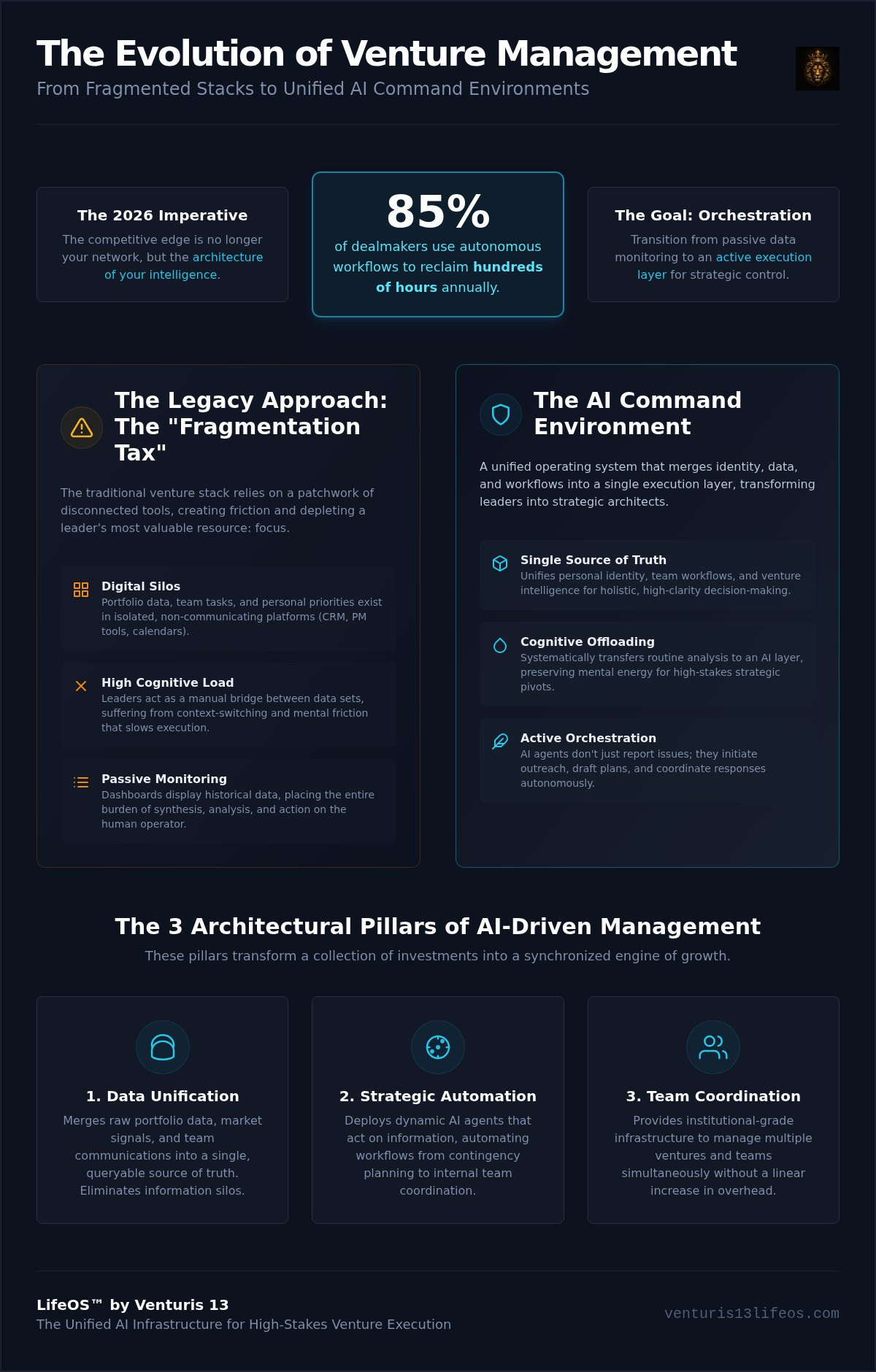
The era of the fragmented venture stack is over. By 2026, the competitive edge in private capital isn't found in the size of your network; it's found in the architecture of your intelligence. You've likely felt the persistent mental friction of switching between personal priorities, team updates, and market signals. This cognitive tax slows your response, clouds your vision, and delays your execution. Mastering AI for venture portfolio management is no longer a luxury; it's a foundational requirement for survival in a landscape where 85% of dealmakers now leverage autonomous workflows to reclaim hundreds of hours per year.
You deserve a system that eliminates noise, enforces discipline, and scales with your ambition. This guide reveals how a unified command environment transforms fragmented venture data into a structured system for strategic decision-making and scalable growth. We'll explore the transition from passive tracking to active orchestration. You'll discover how LifeOS™ by Venturis 13 creates a single source of truth, automates strategic workflows, and reduces cognitive load through unified intelligence. The future of venture management isn't about adding more tools. It's about deploying a superior operating system.
Key Takeaways
- Transition from passive data monitoring to a proactive execution layer that unifies founder identity with venture intelligence.
- Discover how AI for venture portfolio management transforms fragmented information into a structured system for strategic autonomy and scalable growth.
- Evaluate the architectural limitations of legacy SaaS tools compared to a unified AI operating system designed for high-stakes coordination.
- Implement a two-step framework to audit digital silos and construct a centralized command environment for precise decision-making.
- Leverage the LifeOS Enterprise Plan to orchestrate complex venture workflows through a single, intelligent source of truth.
Table of Contents
- Beyond Tracking: The Shift to AI-Driven Venture Command Environments
- The Mechanics of AI Venture Portfolio Management: Integration and Autonomy
- Strategic Comparison: Why Point Solutions Fail Where an AI Operating System Succeeds
- Designing Your Venture Execution Layer: A Framework for Strategic Control
- LifeOS™: The Unified AI Infrastructure for High-Stakes Venture Execution
Beyond Tracking: The Shift to AI-Driven Venture Command Environments
The traditional dashboard is a relic. For decades, the industry has relied on passive monitoring tools that merely display historical data, leaving the burden of synthesis and action entirely on the human operator. This legacy approach is insufficient for the velocity of 2026. High-stakes AI for venture portfolio management requires a fundamental shift from observation to orchestration. We are witnessing the rise of the command environment: a unified infrastructure designed for decisions, coordination, and action.
Founders and partners currently pay a "fragmentation tax" that depletes their most valuable resource: focus. When personal priorities, team workflows, and Venture capital (VC) portfolio insights exist in isolated silos, strategic clarity vanishes. This separation creates mental friction. It forces the leader to act as a manual bridge between disparate data sets. A true command environment eliminates this tax by merging these streams into a single, autonomous execution layer. It transforms the role of the GP from a data-gatherer into a strategic architect.
The Architecture of Unified Intelligence
Strategic clarity is an architectural achievement. It's not found in the features of a tool, but in the integration of intelligence. By merging personal identity with venture execution, leaders gain a holistic view of their influence and obligations. AI for venture portfolio management serves as the connective tissue in this ecosystem. It processes raw portfolio data, identifies emerging signals, and translates them into structured business outcomes. When identity and venture intelligence coexist, the system doesn't just show you what is happening; it tells you what must be done next. This fusion ensures that every action is aligned with high-level governance, discipline, and scalability.
Eliminating Mental Friction for Strategic Leaders
Context switching is the enemy of high performance. Moving between a CRM for deal flow, a project manager for team tasks, and a personal calendar for private priorities creates a chaotic energy that inhibits deep thought. Modern venture leaders are moving away from this frantic state toward a calm, hyper-competent emotional state powered by cognitive offloading. By delegating the heavy lifting of data synthesis to an intelligent OS, leaders reclaim their mental bandwidth. They stop managing tools and start leading ventures.
Cognitive offloading in venture management is the systematic transfer of routine analytical and operational burdens to an autonomous AI layer, preserving the leader's mental energy for high-stakes strategic pivots. This shift allows for the coordination of multiple teams simultaneously without increasing the leader's cognitive load. It's a silent engine of efficiency that operates with invisible precision, turning passive thought into active, structured output.
The Mechanics of AI Venture Portfolio Management: Integration and Autonomy
Execution is the only metric that matters. In the high-velocity environment of 2026, the distance between a strategic insight and a measurable outcome must be compressed to near-zero. This compression requires more than just better software; it demands an autonomous execution layer. Modern AI for venture portfolio management rests on three architectural pillars: data unification, strategic automation, and team coordination. These pillars transform a collection of investments into a synchronized engine of growth. While legacy tools merely display data, an intelligent command environment deploys it.
The transition from passive monitoring to active autonomy is driven by AI agents. These are not static scripts; they are dynamic entities capable of acting on information. They don't simply alert you to a portfolio company's declining runway; they initiate the outreach, draft the contingency plan, and coordinate the internal response. This institutional-grade infrastructure provides the scalability required to manage multiple ventures without a linear increase in overhead. It is the bridge between high-level strategy and the relentless pursuit of progress. Founders seeking to build this institutional-grade execution layer often turn to LifeOS to unify their venture intelligence.
Strategic Workflow Automation
Task management is a legacy concept. The modern leader requires autonomous execution cycles that move beyond simple checklists. AI coordinates complex workflows across multiple venture teams, ensuring that every action is mapped to a strategic objective. It identifies dependencies, allocates resources, and anticipates bottlenecks before they manifest. This shift from linear project management to autonomous orchestration allows the silent engine of the OS to maintain momentum while the leader focuses on high-stakes pivots. It is a system of governance, discipline, and results.
Unified Data for High-Stakes Decisions
Static monthly reports are obsolete. In a market where 82% of venture firms now use AI for deal sourcing research, the speed of your internal intelligence must match the speed of the market. Real-time portfolio insights allow for immediate pattern recognition across diverse sectors, revealing risks and opportunities that remain invisible in siloed systems. Adhering to fiduciary duties for AI in investment requires more than just intent; it requires an infrastructure that ensures data integrity and algorithmic transparency. This rigorous approach to data governance provides the foundation for both internal excellence and external reporting to limited partners. AI for venture portfolio management ensures that your decision-making is grounded in a single, unassailable source of truth.
Strategic Comparison: Why Point Solutions Fail Where an AI Operating System Succeeds
Point solutions are a tax on vision. In the pursuit of efficiency, many firms have inadvertently constructed a fragmented SaaS stack that demands constant maintenance and manual oversight. Legacy collaboration platforms and general-purpose task managers, while competent for basic project tracking, lack the architectural depth required for high-stakes execution. They are passive repositories. Effective AI for venture portfolio management requires a fundamental departure from this point-solution paradigm. The shift is categorical: moving from software-as-a-service to infrastructure-as-an-OS.
A common objection arises: why not simply bridge these gaps with custom integrations? The reality is that interconnected ecosystems built on third-party automation create a fragile web of dependencies. They lack a central intelligence core. Custom integrations often lead to integration debt, where the leader becomes the permanent administrator of a collapsing digital house of cards. LifeOS™ by Venturis 13 replaces this chaos with a unified AI Operating System. It's the difference between a collection of disconnected parts and a single, high-performance machine designed for governance, discipline, and results.
Venture Infrastructure vs. Productivity Apps
General-purpose apps are designed for the average user, not the strategic architect. They lack the execution layer necessary to translate complex venture intelligence into coordinated action. Managing a venture's collective intelligence is not the same as managing a to-do list. It requires a system that understands context, anticipates risks, and orchestrates workflows across multiple teams simultaneously. For those seeking to master this level of control, building a robust Digital Architecture for High Achievers is the first step toward institutional-grade performance. Legacy tools offer features; an OS offers a blueprint for victory.
The ROI of Unified Intelligence
The return on investment for a unified operating system is measured in reclaimed focus and reduced risk. By deploying AI for venture portfolio management within a single command environment, firms can eliminate the hidden costs of context switching and data duplication. An integrated system ensures that strategic misalignment is identified and corrected in real-time, rather than discovered during a quarterly review. The long-term scalability of an OS-based approach is undeniable. While tool-bloat creates friction that slows growth, a unified infrastructure provides the silent engine of efficiency that accelerates it. It's a transition from frantic energy to disciplined, hyper-competent execution.
Designing Your Venture Execution Layer: A Framework for Strategic Control
Strategy is a blueprint; execution is the building. To master the complexities of modern capital, a leader must move beyond the "fragmentation tax" of disconnected tools and design a robust execution layer. This layer serves as the connective tissue between high-level vision and daily operations. Effective AI for venture portfolio management requires a framework that bridges the gap between vision and reality, turning passive thought into structured, measurable progress. To begin building your institutional-grade infrastructure, explore the LifeOS™ by Venturis 13 Enterprise Plan today.
Building this layer follows a disciplined, five-step architectural process:
- Step 1: Audit Digital Architecture. Identify, isolate, and eliminate silos. You must pinpoint where data dies and where manual context switching between legacy documentation tools slows your momentum.
- Step 2: Define the Command Center. Establish a single source of truth. This environment must unify personal priorities with venture intelligence to ensure total strategic alignment through LifeOS™ by Venturis 13.
- Step 3: Implement Strategic Automation. Move beyond simple task management. Deploy autonomous execution cycles for recurring venture requirements like runway monitoring and market signal detection.
- Step 4: Align Team Execution. Use unified intelligence to ensure every team member operates from the founder’s priorities. Coordination must be seamless, invisible, and absolute.
- Step 5: Measure AI-Driven Outcomes. Abandon vanity metrics. Focus on outcomes that reflect actual portfolio health and strategic growth, powered by real-time analytical synthesis.
Managing Multiple Ventures with Clarity
Maintaining high-level control across diverse industries demands a system that scales without increasing cognitive load. The modern architect uses AI for venture portfolio management to enable summary-to-detail drill-downs. This allows a leader to view the entire portfolio’s health in a single glance, then instantly descend into the granular mechanics of a specific venture's execution. By structuring team coordination around a unified OS, you ensure that growth is not just possible, but predictable. It's the transition from managing people to managing systems.
The Role of AI in Governance and Risk
Compliance is not a checkbox; it's a system. In an environment where regulatory scrutiny is increasing, automating risk assessment at the portfolio level is essential for institutional-grade governance. AI ensures that every team remains aligned with core strategic goals, flagging deviations before they become liabilities. Real-time governance in multi-venture environments provides the necessary guardrails for aggressive, scalable expansion while maintaining fiduciary integrity. This silent engine of oversight allows the leader to focus on high-stakes pivots with the certainty that the foundation is secure.
LifeOS™: The Unified AI Infrastructure for High-Stakes Venture Execution
The search for a superior competitive advantage ends with the architecture of your operating system. LifeOS™ is the category-defining infrastructure designed specifically for founders and ventures who demand total strategic control. It is not another software tool to be managed; it is a silent engine that operates with invisible efficiency. By deploying AI for venture portfolio management through a unified OS, you eliminate the friction of disparate systems. This platform positions the leader as a strategic architect, providing the clarity, discipline, and results necessary for institutional-grade performance.
The LifeOS Enterprise Plan extends this power to the entire organization. It facilitates high-level venture control and seamless team coordination, ensuring that every participant moves in lockstep with the founder’s vision. This is the only environment that unifies personal performance with professional outcomes. It recognizes that a venture's success is inseparable from the leader's cognitive capacity. When your personal priorities and venture intelligence exist in one ecosystem, you achieve a state of hyper-competent management that legacy funds cannot match.
From Ambition to Structured Outcomes
Ambition without architecture is merely noise. LifeOS™ transforms fragmented goals into a series of coordinated, autonomous actions. It provides a command environment that evolves alongside your venture's scale, adapting to increasing complexity without sacrificing precision. This system ensures that your strategic execution remains robust as you expand into new markets or diverse industries. Establishing this level of control requires a commitment to a new standard of Executive Productivity Infrastructure. It is the transition from passive thought to active, structured output.
The Future of Venture Management is Autonomous
The gap between the traditional fund and the AI-powered venture is widening. In 2026, waiting to adopt a unified AI Operating System is the single greatest risk a founder can take. While others struggle with tool-bloat and context switching, the LifeOS™ user operates from a position of calm, hyper-intelligent focus. Success in this new landscape requires more than just better data; it requires a superior execution layer. Join the evolution of digital architecture with Venturis 13 and reclaim your strategic momentum. The time for fragmented management has passed. It is time to Experience the LifeOS™ Command Environment and lead your ventures with absolute certainty.
Secure Your Strategic Advantage in the Autonomous Era
The transition from fragmented point solutions to a unified AI Operating System is the defining shift for the modern founder. You've seen how legacy tools fail to bridge the gap between vision and execution, creating a fragmentation tax that drains your focus. By building a command environment, you transform passive tracking into active orchestration. This architecture ensures that your personal priorities and venture intelligence operate as a single, high-performance machine. It's a move toward order, clarity, and the elimination of mental friction.
Deploying AI for venture portfolio management is no longer a matter of choice; it's a matter of survival. Success in 2026 requires enterprise-grade venture infrastructure that unifies personal and professional intelligence into one source of truth. As a category-defining AI Operating System, LifeOS™ provides the silent engine necessary for disciplined growth and absolute clarity. The blueprint for victory is ready for your deployment. You've mastered the complexities of modern life; now it's time to offer that same blueprint to your ventures.
Build your venture infrastructure with LifeOS™
Your journey toward hyper-competent execution starts with a single, decisive step. Embrace the order and scalability that your ambition deserves.
Frequently Asked Questions
What is an AI command environment for venture portfolio management?
An AI command environment is a unified digital infrastructure that unifies fragmented portfolio data into a single execution layer for strategic action. It moves beyond passive monitoring by integrating personal priorities with venture intelligence. This architectural approach allows leaders to orchestrate complex workflows with absolute clarity, discipline, and results. It is the silent engine that transforms passive thought into structured output.
How does AI improve decision-making for venture capital firms?
AI enhances decision-making by transforming raw data into structured, real-time insights that reveal emerging market signals. By leveraging AI for venture portfolio management, firms can identify pattern recognition across diverse sectors that remain invisible to legacy systems. This synthesis reduces cognitive load and ensures every pivot is grounded in a single source of truth. It allows for a calm, hyper-competent state of leadership.
Can AI manage multiple ventures simultaneously without human intervention?
AI provides the execution layer for multiple ventures through autonomous workflows, though human oversight remains the strategic anchor. While AI agents handle routine coordination, compliance, and data synthesis, the founder retains final governance. This synergy creates an engine of efficiency that scales without increasing the leader's mental friction. It is a system of integration, autonomy, and orchestration designed for high-performance partners.
What is the difference between a venture CRM and an AI operating system?
A venture CRM is a passive repository focused on relationship tracking and historical data. In contrast, an AI operating system like LifeOS™ is a proactive infrastructure designed for orchestration and autonomous execution. While a CRM shows you what has happened, an OS tells you what must happen next to achieve your strategic objectives. It represents the transition from software-as-a-service to infrastructure-as-an-OS.
Is LifeOS™ suitable for managing both personal finances and venture workflows?
LifeOS™ is specifically engineered to unify personal priorities, finances, and identity with complex venture workflows. It eliminates the fragmentation tax that occurs when life and business data are siloed. This integration ensures that a founder's personal performance and professional outcomes are synchronized within one hyper-intelligent command environment. It is the only platform that unifies personal and venture intelligence for high-stakes execution.
How does the LifeOS Enterprise Plan coordinate venture teams?
The LifeOS Enterprise Plan establishes a shared execution layer that aligns team actions with the founder's core strategic goals. It automates complex workflows across multiple ventures, ensuring every participant operates from the same unified intelligence. This institutional-grade infrastructure provides the governance and discipline required for scalable, synchronized growth across the entire organization. It is a blueprint for coordinated, high-level venture control.
What are the security implications of using AI for high-stakes venture data?
High-stakes venture data requires an infrastructure that prioritizes data integrity, algorithmic transparency, and robust governance. Modern systems must comply with evolving standards, such as Regulation S-P, to safeguard customer information by the June 2026 deadline. LifeOS™ provides the secure, institutional-grade architecture necessary to manage sensitive intelligence while maintaining fiduciary duties. It ensures that your digital architecture is both resilient and compliant.
Why is a unified digital architecture critical for founders in 2026?
A unified digital architecture is essential to navigate the extreme velocity and complexity of the 2026 venture landscape. Founders who rely on fragmented SaaS stacks face a cognitive tax that slows response times and clouds strategic vision. Transitioning to a unified AI Operating System allows leaders to reclaim their focus, scale their influence, and achieve hyper-competent execution. It is the essential evolution for those who value discipline and scalability.