Automated Venture Infrastructure: The New Architecture for Scaling in 2026
Scalability is no longer a hard-won funding milestone; it is a structural byproduct of an autonomous venture execution layer. In an era where AI startups captured 81% of global venture capital in early 2026, the traditional reliance on headcount to drive growth has become a strategic liability. You likely feel the weight of this transition. Fragmented information, disjointed SaaS tools, and constant context-switching create a ceiling on your ambition. Adopting a unified AI platform for scaling ventures is the only way to break through. It is time to move from the frantic energy of manual coordination toward a calm, disciplined, and hyper-competent state of operation.
This article details the evolution from fragmented software to a unified command environment. You will learn how the LifeOS™ architecture provides the structural clarity required for rapid, institutional-grade scaling. We examine the transition from passive thought to active, structured output. We explore how autonomous workflows eliminate mental friction, ensure strategic governance, and provide the orchestration necessary for modern ventures. By the end, you will understand how to build a venture infrastructure that scales with invisible efficiency.
Key Takeaways
- Recognize the "fragmentation tax" where disconnected SaaS tools erode cognitive performance and stall institutional-grade growth.
- Implement a unified AI platform for scaling ventures to replace fragmented workflows with a cohesive, autonomous execution layer.
- Master the three architectural pillars of Unified Intelligence, Autonomous Action, and Measurable Progress to ensure absolute strategic alignment.
- Execute a five-step audit to identify mental friction points and re-architect your digital environment around your venture's core priorities.
- Leverage the LifeOS™ ecosystem to synchronize personal identity with venture intelligence, creating a high-performance engine of invisible efficiency.
Table of Contents
The Infrastructure Gap: Why Traditional Scaling Fails in 2026
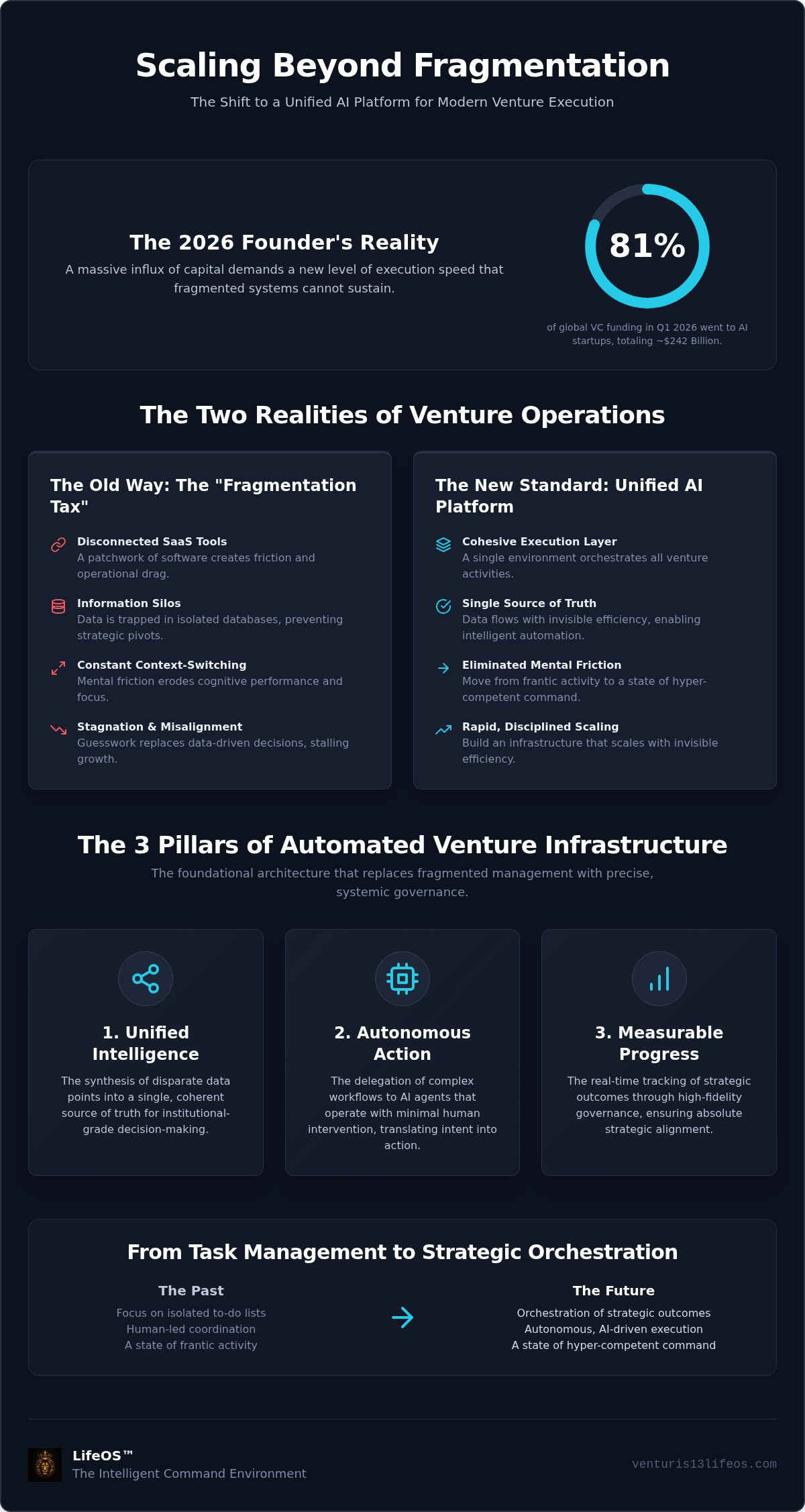
The modern founder operates within a digital paradox. Abundance has bred chaos. While the tools available for venture creation have multiplied, clarity has diminished. In the first quarter of 2026 alone, AI startups captured 81% of global venture capital funding, totaling approximately $242 billion. This massive influx of capital demands a level of execution speed that traditional, fragmented SaaS stacks cannot sustain. Founders are now paying a "fragmentation tax" on their cognitive performance. Every minute spent toggling between disconnected project managers, CRMs, and communication channels is a minute stolen from strategic governance. Relying on a patchwork of tools leads to friction, misalignment, and eventual stagnation. Deploying a sophisticated AI platform for scaling ventures is no longer a luxury; it's the foundational requirement for survival.
The Hidden Cost of Fragmented Data
Information silos are the silent killers of rapid strategic pivots. When venture data is scattered across dozens of platforms, the founder's identity becomes buried under operational noise. Multi-venture management requires a panoramic view that traditional software simply doesn't provide. You can't lead effectively when your team's intelligence is trapped in isolated databases. This lack of integration prevents the implementation of Intelligent Automation, which is essential for streamlining complex business processes. Without a unified data layer, institutional-grade decision-making is replaced by guesswork. The result is an erosion of discipline and a loss of the very structural clarity required to manage high-stakes capital. True scale requires an ecosystem where data flows with invisible efficiency, unburdened by manual synchronization.
From Task Management to Strategic Orchestration
The "to-do list" mentality is an artifact of a slower era. Traditional project management focuses on the completion of isolated tasks, yet 2026 demands the orchestration of entire strategic outcomes. High-performance ventures require more than just a place to track progress; they need an institutional-grade venture execution layer. This shift toward unified intelligence moves the founder away from human-led coordination and toward autonomous execution. An AI platform for scaling ventures acts as a silent engine, translating high-level intent into disciplined action. It bridges the gap between human aspiration and technical output. By replacing fragmented SaaS with a unified Operating System like LifeOS™, you eliminate the mental friction of context-switching. You move from a state of frantic activity to a state of hyper-competent command, where every workflow is an automated extension of your strategic vision.
Defining Automated Venture Infrastructure
Automated Venture Infrastructure is the integrated stack of artificial intelligence, high-fidelity data, and autonomous workflows that governs the entire lifecycle of venture execution. It's the silent engine of the modern firm. Unlike traditional ERP or CRM systems that function as passive archives of historical data, this new architecture operates as a forward-looking coordination layer. It processes, decides, and acts. For the high-performance founder, an AI platform for scaling ventures serves as the definitive bridge between visionary intent and technical reality. It replaces the frantic management of fragmented tools with the precise governance of a unified system.
This architecture is built upon three foundational pillars that ensure institutional-grade quality:
- Unified Intelligence: The synthesis of disparate data points into a single, coherent source of truth.
- Autonomous Action: The delegation of complex workflows to AI agents that operate with minimal human intervention.
- Measurable Progress: The real-time tracking of strategic outcomes through high-fidelity governance.
The Anatomy of a Command Environment
The founder is the architect of their own efficiency. To scale without burnout, you must integrate personal priorities with professional execution. This requires centralizing strategic decisions, finances, and team coordination into a single, high-fidelity interface. A command environment is a unified digital architecture that synchronizes a founder's personal identity and priorities with the strategic execution of their venture teams. By aligning your internal world with your external output, you eliminate the cognitive dissonance that stalls growth. Transitioning to an AI-powered Life and Venture Management system ensures your infrastructure evolves as fast as your ambition.
The Execution Layer: Turning Ambition into Outcomes
Strategy is useless without the mechanics to realize it. The execution layer is where high-level vision meets daily action. Autonomous workflows reduce the need for manual oversight, allowing the founder to focus on governance rather than granular tasks. This transition relies heavily on structured data. Without a rigorous data architecture, automation fails. A robust AI platform for scaling ventures ensures that every piece of information is captured, categorized, and utilized. It bridges the gap between passive thought and active, structured output. This institutional-grade approach ensures that the venture doesn't just grow; it scales with invisible efficiency and absolute strategic alignment.
SaaS Fragmentation vs. Unified AI Operating Systems
The "Best-of-Breed" era has reached its logical conclusion: systemic failure. For years, founders were encouraged to assemble a mosaic of specialized applications, resulting in a digital landscape defined by sprawl, friction, and noise. By 2026, this approach has transformed from a strategic choice into a profound liability. Managing a dozen disconnected subscriptions doesn't just drain capital; it erodes the cognitive bandwidth required for visionary leadership. A unified AI platform for scaling ventures offers a definitive departure from this chaos. It replaces the frantic management of silos with the disciplined orchestration of a single ecosystem. It's the difference between a collection of parts and a high-performance machine.
The shift is also reflected in the market's economic reality. Traditional per-seat pricing has plummeted from 21% to just 15% of vendors, replaced by hybrid and outcome-based models that prioritize results over access. Subscription fatigue is not merely a financial concern. It's a symptom of structural inefficiency. An integrated Operating System provides a superior cost-benefit profile by consolidating data, workflows, and intelligence into a cohesive layer. This architecture delivers three critical advantages: clarity, speed, and strategic dominance.
The Logic of the Unified OS
Strategic control is impossible within a linear system. Traditional software requires the human founder to act as the primary integration point, manually bridging the gap between apps. An AI Operating System reverses this dynamic through cognitive offloading. It creates a single source of truth that processes information in real-time, allowing for rapid, high-fidelity decision-making. By centralizing your venture intelligence, you move beyond the manual coordination of tasks to a state of absolute command. It’s about synthesis, autonomy, and the elimination of mental friction.
Institutional Grade Venture Management
Scaling a venture requires the seamless coordination of collective intelligence. Fragmented tools fail when teams expand across global time zones and complex workflows. This is where the LifeOS Enterprise Plan becomes the essential infrastructure for the modern firm. It provides the unified architectural governance necessary to synchronize venture teams with the founder's core priorities. Whether managing a single startup or a portfolio of interests, the OS ensures that every team member operates from the same strategic blueprint. It’s an institutional-grade solution that transforms fragmented ambitions into structured, measurable outcomes.
Designing Your Digital Architecture: A 5-Step Guide
Scaling is not an accident of effort; it is an outcome of design. To transition from a fragmented operator to a strategic architect, you must follow a rigorous blueprint. This shift requires moving beyond the frantic energy of manual coordination toward a state of hyper-competent command. The following five steps provide the structural foundation for your evolution, ensuring your infrastructure is built for institutional-grade growth.
- Friction Audit: Identify where the fragmentation tax is highest. Pinpoint the specific tools, manual data entries, and disjointed workflows that create mental drag and stall execution.
- Identity Alignment: Define the core priorities of the venture as a direct extension of your personal strategic intent. Ambiguity at this level leads to systemic rot and organizational misalignment.
- Autonomous Mapping: Transition high-impact workflows to an AI platform for scaling ventures. This creates an execution layer that functions with minimal human intervention, allowing for rapid, disciplined expansion.
- KPI Integration: Merge personal performance metrics with venture growth indicators. Your focus, cognitive load, and strategic clarity are the leading indicators of firm health.
- Command Deployment: Establish a unified environment for real-time governance. This centralizes strategic decisions, finances, and team coordination into a single, high-fidelity interface.
Mapping the Venture Execution Layer
Success requires moving beyond the "best guess" mentality. You must identify the workflows that drive the highest leverage and translate them into structured protocols. This is the essence of a digital architecture for high achievers. By shifting from intuition to data-driven action, you ensure that every decision is backed by institutional-grade intelligence. The AI platform for scaling ventures acts as the substrate for this transition, providing the orchestration needed to manage complex global teams with absolute precision. It bridges the gap between visionary ambition and technical output, ensuring that every action is an extension of your strategic blueprint.
Reducing Mental Friction for High Achievers
The modern founder is often a victim of their own success, drowning in the noise of multi-venture management. Cognitive offloading is the primary defense against this erosion of focus. You must structure your Operating System to handle the operational details, leaving your mind free for high-level governance. It's about maintaining focus on the "one thing" that matters while the "many" scale autonomously in the background. Order, discipline, and clarity are the rewards of this architectural shift. To begin your transition into a state of hyper-competent command, explore the LifeOS™ Enterprise Plan today. This is the silent engine that operates with invisible efficiency, turning your strategic vision into a scalable reality.
LifeOS™: The Intelligent Command Environment for 2026
LifeOS™ represents the ultimate evolution of venture infrastructure. It isn't merely a tool; it's a category-defining environment that serves as the definitive AI platform for scaling ventures. This architecture provides the structural substrate where personal identity and professional execution finally converge. It's here that fragmented ambitions are distilled into structured outcomes through a unified layer of intelligence. By 2026, the distinction between a founder's strategic intent and their team's technical output has vanished. LifeOS™ acts as the silent engine of the firm, ensuring every action aligns perfectly with the overarching architectural blueprint. It replaces the frantic energy of manual coordination with a state of hyper-competent command, allowing you to scale with invisible efficiency.
The Architecture of Unified Intelligence
True scale requires more than just efficient task management; it demands the orchestration of collective intelligence across every facet of your life. LifeOS™ bridges the gap between the founder’s personal priorities and the venture’s growth by centralizing decision support and workflow automation. This is the new standard for executive productivity infrastructure. It eliminates the cognitive dissonance of context-switching by providing a single, high-fidelity source of truth. Whether you're managing complex finances or coordinating global teams, the environment remains calm, disciplined, and hyper-competent. This unified intelligence ensures that no strategic detail is lost in the noise of operations.
For the serial entrepreneur, the LifeOS Enterprise Plan provides the unified coordination required for large-scale operations. It moves beyond the limitations of traditional SaaS by focusing on autonomous execution and strategic governance. This is an institutional-grade solution designed to handle the complexity of modern markets. It allows venture teams to operate as synchronized extensions of the founder's vision. By integrating personal performance with venture intelligence, LifeOS™ creates a robust ecosystem where growth is a structural certainty rather than a manual effort.
Transforming Ambition into Measurable Progress
Venturis 13 has engineered a system that translates visionary goals into automated execution. This is not a passive archive of data but an active participant in your venture's success. By deploying this AI platform for scaling ventures, you move from passive thought to active, structured output. The transition from manual oversight to autonomous governance is now complete. Order replaces chaos. Clarity replaces noise. Discipline replaces friction. Every workflow within the system is designed to drive measurable progress, turning high-level strategy into a series of inevitable results.
The future of venture management is here, and it's governed by a unified command environment. It's a world where intelligence and action are seamlessly fused. You're no longer required to bridge the gaps between disconnected tools; the infrastructure does it for you. Take the next step in your evolution by implementing the definitive AI operating system for the high-performance firm. Secure your strategic dominance and build the infrastructure of the future today.
The Architecture of Strategic Dominance
Strategic dominance in 2026 is reserved for those who replace fragmented effort with architectural precision. You've identified the infrastructure gap, defined the execution layer, and mapped the path toward unified intelligence. The transition is clear. You must move away from the noise of disjointed SaaS toward a high-performance AI platform for scaling ventures. This isn't just about efficiency; it's about governance, autonomy, and the elimination of mental friction. By centralizing your venture intelligence, you create a silent engine that operates with invisible efficiency.
LifeOS™ provides the category-defining AI Operating System required to turn visionary ambition into structured reality. Through an autonomous execution layer and institutional-grade venture management, it synchronizes your personal identity with your professional output. Order, discipline, and clarity are no longer goals; they are the structural substrate of your firm. The blueprint for your evolution is ready. It's time to move beyond manual coordination and enter a state of hyper-competent command.
Architect your venture’s future with LifeOS™
Step into the future of intelligent execution and lead your venture toward its inevitable success.
Frequently Asked Questions
What is automated venture infrastructure and how does it differ from a CRM?
Automated venture infrastructure is a unified execution layer that governs strategic workflows, whereas a CRM is merely a passive archive of relationship data. While a CRM tracks historical interactions, this infrastructure acts as a forward-looking orchestration engine. It processes data, makes autonomous decisions, and executes complex tasks. It replaces fragmented tools with a single, high-fidelity command environment that dictates action rather than just recording history.
Can an AI operating system manage multiple companies at once?
Yes, a robust AI operating system is specifically designed to centralize the governance of diverse portfolios. It allows serial entrepreneurs to maintain a panoramic view of multiple ventures without the cognitive load of context-switching. By unifying data and workflows, the system ensures that each company operates according to its specific strategic blueprint. This architecture provides the structural clarity required for multi-venture dominance and disciplined growth.
How does unified intelligence help founders reduce mental friction?
Unified intelligence reduces mental friction by centralizing disparate data points into a single source of truth. This eliminates the fragmentation tax caused by toggling between disconnected SaaS tools. When information is synthesized and accessible through an AI platform for scaling ventures, the founder can focus on high-level governance. Cognitive offloading becomes a reality, allowing for a calm, disciplined, and hyper-competent state of leadership.
Is automated venture infrastructure suitable for early-stage startups?
Early-stage startups benefit significantly from implementing this infrastructure because it establishes a scalable foundation from day one. Instead of accumulating operational debt through fragmented software, founders can deploy a unified system that grows with the venture. This institutional-grade approach ensures that early workflows are structured and measurable. It positions the startup as a high-performance machine ready for rapid expansion and institutional capital.
What are the security implications of using an AI command environment?
Security within an AI command environment relies on robust governance and transparency, aligned with regulations like the EU AI Act of August 2026. These systems prioritize data integrity by centralizing information within a secure, integrated architecture. By reducing the number of third-party SaaS integrations, founders actually minimize their total attack surface. High-fidelity systems ensure that venture intelligence remains protected through rigorous encryption and specialized access controls.
How do I transition from traditional SaaS tools to a unified AI OS?
Transitioning requires a systematic audit of your current operational friction points and data silos. You begin by mapping your core priorities and high-impact workflows to the new execution layer. Most founders phase out fragmented tools as they migrate their data into the AI platform for scaling ventures. This methodical shift ensures that the venture remains operational while moving toward a state of invisible efficiency and strategic alignment.
What role does personal identity play in venture scaling?
Personal identity is the primary driver of strategic intent, and its integration with venture intelligence is essential for sustainable growth. When a founder's priorities are synchronized with their venture's workflows, the risk of misalignment vanishes. This synergy ensures that the venture scales as a direct extension of the founder's vision. A unified OS preserves this connection, turning personal ambition into measurable progress through disciplined architectural design.
How does LifeOS™ Enterprise coordinate large venture teams?
LifeOS™ Enterprise coordinates teams by providing a unified architectural governance layer that synchronizes collective intelligence across global workflows. It allows for the delegation of complex tasks to autonomous agents while maintaining absolute strategic oversight. Teams operate from a single source of truth, eliminating the noise of disjointed communication. This institutional-grade coordination ensures that every team member is aligned with the venture's core priorities and the strategic blueprint.