Digital Infrastructure for Serial Entrepreneurs: Building the 2026 AI Command Center
The era of the fragmented founder is over. Managing twenty disconnected SaaS subscriptions is no longer a badge of honor; it's a structural failure that hemorrhages cognitive capital. You're likely exhausted by the constant friction of switching between disparate dashboards, calendars, and communication channels. This guide introduces a definitive shift toward the AI operating system for ventures, a unified execution layer designed to replace chaos with orchestration, clarity, and control.
Scaling personal output alongside venture growth requires more than just better habits. It demands a sophisticated digital architecture that bridges the gap between your personal identity and your professional output. We'll examine how to build a 2026 command center that eliminates information silos, automates routine governance, and provides total strategic oversight. By the end of this article, you'll understand how to transform your digital environment into a silent engine of discipline, scalability, and results. You'll master the transition from passive thought to active, structured, and autonomous output.
Key Takeaways
- Identify and eliminate the hidden "fragmentation tax" to recover cognitive capital and restore strategic momentum across your portfolio.
- Master the architectural shift toward a unified AI operating system for ventures that orchestrates autonomous agents, data logic, and strategic governance.
- Synchronize your personal performance with venture execution by building a digital infrastructure that merges identity, priorities, and professional output.
- Execute a systematic friction audit to pinpoint manual bottlenecks and consolidate fragmented tools into a single, high-performance execution layer.
- Leverage LifeOS™ as a silent engine to coordinate complex venture workflows while maintaining total alignment with your personal and financial goals.
Table of Contents
- The Fragmentation Tax: Why Traditional Digital Infrastructure Fails Serial Entrepreneurs
- Defining the AI Operating System for Ventures: Beyond Task Management
- The Architectural Pillars of a High-Performance Venture Execution Layer
- Auditing and Upgrading Your Digital Infrastructure: A Founder’s Roadmap
- LifeOS™: The Intelligent Command Environment for Scalable Venture Management
The Fragmentation Tax: Why Traditional Digital Infrastructure Fails Serial Entrepreneurs
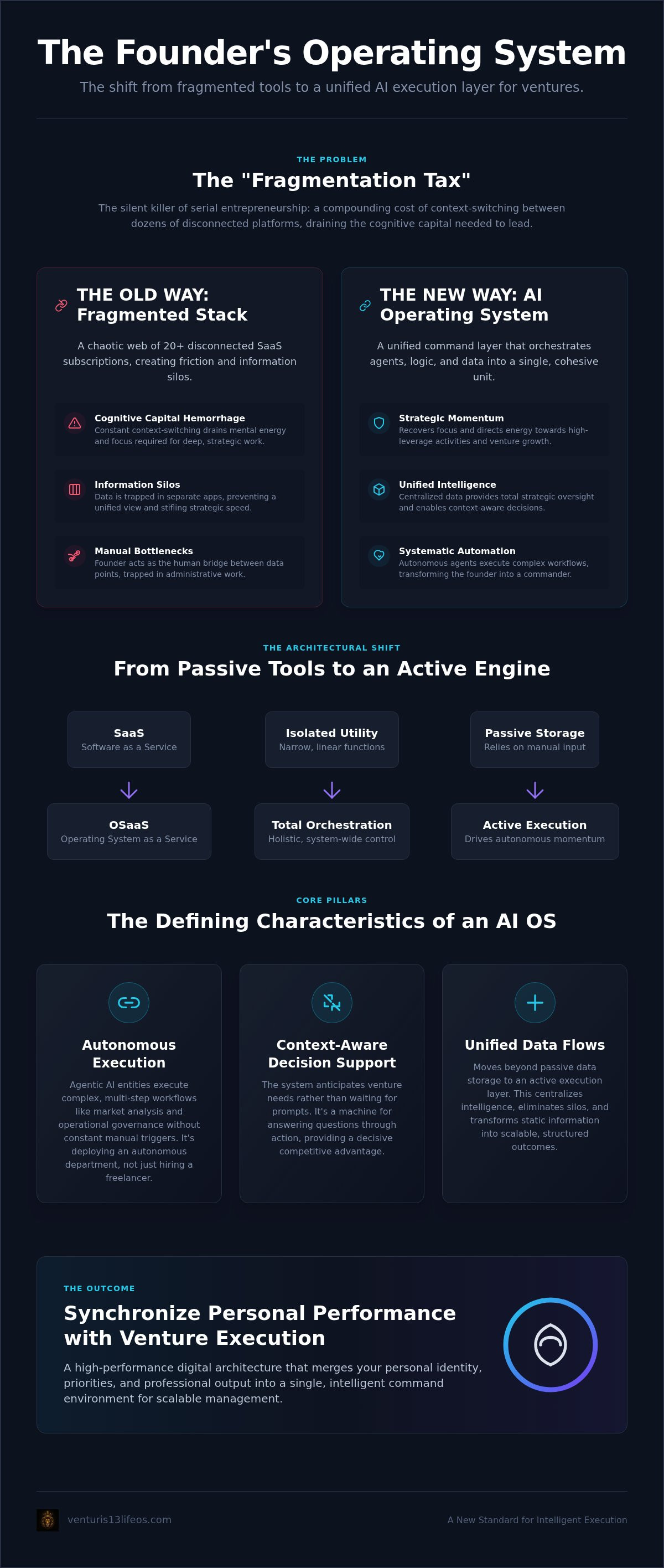
The fragmentation tax is the silent killer of serial entrepreneurship. It represents the compounding cost of context switching between dozens of disconnected platforms that fail to communicate. Traditional SaaS tools were built for narrow, linear utility rather than the holistic orchestration required by a high-stakes founder. These legacy systems create information silos that stifle strategic speed. They force you to act as the manual bridge between your own data points, draining the very cognitive capital you need to lead.
By 2026, the threshold for app fatigue has been breached. Adding more tools no longer increases your ROI; it actively decreases your capacity for deep work. Your existing tech stack is likely obsolete because it relies on passive storage rather than active execution. A modern founder needs an AI operating system for ventures that functions as a unified command layer, transforming static data into autonomous momentum.
The Cognitive Load of Multi-Venture Management
Managing multiple entities requires a level of mental clarity that fragmented data destroys. When your intelligence is scattered, your actions become uncoordinated and your progress remains invisible. This triplet of friction leads directly to decision paralysis. Founders who fail to transition to an executive productivity infrastructure find themselves trapped in the administrative weeds of their own creation. True scale is impossible when you're manually syncing priorities across different companies and personal dashboards.
Siloed Intelligence vs. Unified Command
Separating personal performance from professional venture execution is a structural error. This division creates a ceiling on your ability to scale. Mental friction isn't just an annoyance; it's a drag on your entire ecosystem. The evolution of the business operating system now demands a total integration of life and business. You don't need another task manager. You need a command environment where personal identity and professional output are perfectly synchronized. An AI operating system for ventures provides this orchestration, moving you from passive thought to structured, scalable outcomes.
Defining the AI Operating System for Ventures: Beyond Task Management
An AI operating system for ventures is not a collection of chat interfaces or a sophisticated filing system. It is a comprehensive architectural environment that coordinates agents, logic, and data into a single, cohesive unit. This represents a fundamental shift from the era of Software as a Service (SaaS) to Operating System as a Service (OSaaS). While SaaS focuses on isolated utility, OSaaS focuses on total orchestration. It is the backbone of the modern enterprise, providing the structural integrity required to transform raw information into scalable outcomes.
A true AI OS possesses three defining characteristics: autonomous execution, context-aware decision support, and unified data flows. It doesn't wait for a prompt; it anticipates the needs of the venture. It isn't just a "brain" for asking questions. It is a machine for answering them through action. By centralizing the execution layer, founders move from managing a library of tools to commanding a singular, high-performance engine.
Agentic Orchestration: The New Execution Layer
The core of this system is Agentic AI. These are goal-driven entities that execute complex tasks without the need for constant manual triggers. In a traditional setup, you use AI as a tool. In an AI operating system for ventures, you operate within an AI environment. The system orchestrates these agents to handle multi-step workflows, such as market analysis, financial modeling, and operational governance, simultaneously. This orchestration ensures that every agent is aligned with the overarching strategic vision, eliminating the friction of manual oversight. It's the difference between hiring a freelancer and deploying an autonomous department.
Context-Aware Infrastructure
Unified intelligence is the ultimate competitive advantage for the serial entrepreneur. A sophisticated AI OS understands the intricate relationship between your personal performance goals and your venture's key performance indicators. It recognizes that a founder's health, focus, and financial status are not separate from the health of their companies. Research regarding AI's role in venture building highlights that the most successful integrations focus on this holistic alignment.
By merging these data streams, the system provides high-stakes decision support that is grounded in the reality of your entire ecosystem. This level of AI for high-level venture control allows leaders to maintain absolute clarity while scaling multiple entities. You aren't just looking at a spreadsheet; you're viewing a living map of your entire professional and personal identity. Consider how a unified venture infrastructure could stabilize your executive output and eliminate the mental drag of disconnected systems.
The Architectural Pillars of a High-Performance Venture Execution Layer
Constructing a resilient command center requires a structural framework that supports high-velocity growth across a diverse portfolio. An AI operating system for ventures is built upon four architectural pillars designed to facilitate order, clarity, and the elimination of mental friction. These pillars transform your digital environment from a collection of static tools into an active, high-performance machine.
- Pillar 1: Unified Identity and Priorities. This layer merges your personal ambition with professional objectives, ensuring every action reflects your core values and long-term vision.
- Pillar 2: Autonomous Workflow Engines. Moving beyond manual tracking, this pillar focuses on automated outcomes where agentic workflows handle execution without intervention.
- Pillar 3: Strategic Decision Support. High-level AI analysis provides the strategic clarity needed for bold leadership, replacing guesswork with data-driven certainty.
- Pillar 4: Coordinated Team Intelligence. This architecture aligns your teams through a single source of truth, ensuring perfect synchronization across all ventures.
Merging Personal and Venture Intelligence
Your personal performance is the lead indicator for venture success. Health, finances, and time are the primary resources fueling your companies, yet traditional setups treat them as separate silos. A robust AI operating system for ventures tracks these metrics in parallel with business KPIs to ensure you aren't scaling at the cost of your own stability. It recognizes that a founder's focus is the most valuable asset in the ecosystem. Unified Intelligence is the fusion of personal and professional data.
Institutional-Grade Venture Management
Startups can now access the same level of governance and control as major enterprises through sophisticated AI infrastructure. This institutional-grade approach relies on structured decisions to maintain speed during rapid scaling. Without this foundation, growth quickly leads to operational collapse. It's why generic workspace tools aren't enough; you need a system built specifically for execution. Understanding why intelligent execution goes beyond workspace management reveals the necessity of a silent engine like LifeOS™ by Venturis 13 that manages your entire portfolio, ensuring every move is disciplined and focused entirely on results.
Auditing and Upgrading Your Digital Infrastructure: A Founder’s Roadmap
Transitioning to an AI operating system for ventures is a high-stakes architectural overhaul. It isn't a mere software swap. It's a strategic realignment of how you process information, execute decisions, and govern your portfolio. Founders often fail because they treat AI as a peripheral add-on rather than the structural foundation. This roadmap provides the definitive blueprint for moving from a fragmented collection of tools to a singular, high-performance command center.
- Step 1: The Friction Audit. Identify exactly where data is trapped and where manual effort remains highest. These are your infrastructure leaks.
- Step 2: Consolidating the Execution Layer. Move beyond disconnected task managers. Establish a central OS that acts as your primary command environment.
- Step 3: Defining Autonomous Workflows. Map your repeat venture processes. Define the logic and governance required for total AI delegation.
- Step 4: Integrating Unified Intelligence. Connect your personal priorities and finances directly to the command center. Ensure the system sees the whole picture.
- Step 5: Scaling the Infrastructure. Once the core logic is sound, deploy the system across every entity in your portfolio to ensure universal orchestration.
Identifying Infrastructure Gaps
Most founders mistake passive storage for active execution. If your current stack requires you to manually move data between platforms, it isn't a system; it's a chore. Audit your environment with a critical eye. Does your stack provide proactive strategic alerts? Is your personal performance data visible alongside your business KPIs? Does the system execute complex workflows without a manual trigger? If the answer is no, your productivity tools are actively slowing you down. Digital architecture is most critical during the first 100 days of a new venture. Setting a disciplined foundation early prevents the structural rot that kills scalability later.
The Transition from SaaS to OS
Migrating from legacy systems and fragmented productivity apps requires a fundamental shift in how you view data. You aren't just moving documents. You're training your AI agents on your specific venture logic, strategic priorities, and operational standards. This transition reduces the human-in-the-loop requirement for routine operations, freeing you for high-level strategic governance. The goal is to move from managing tools to orchestrating outcomes. By embedding your unique strategic DNA into the AI operating system for ventures, you create a silent engine that operates with invisible efficiency. You can begin this transformation by evaluating your current AI business infrastructure for ventures to identify exactly where your execution layer is hemorrhaging capital.
LifeOS™: The Intelligent Command Environment for Scalable Venture Management
LifeOS™ represents the definitive evolution of the AI operating system for ventures. It is a category-defining infrastructure that eliminates the artificial boundary between your personal identity and your professional execution. By unifying your priorities, finances, and long-term vision into a single command environment, LifeOS™ transforms fragmented ambitions into structured decisions. It's the silent engine that orchestrates your entire ecosystem with invisible efficiency, providing the clarity, discipline, and scalability required for multi-venture success.
The LifeOS Enterprise Plan extends this orchestration to your entire team. It coordinates complex workflows, manages venture governance, and scales operations across multiple entities without increasing your personal cognitive load. You aren't just managing a business; you're governing a portfolio of scalable outcomes. This plan provides the institutional-grade control necessary for rapid growth, ensuring that every team member operates within the same unified logic and strategic framework.
A Single System for Multi-Venture Mastery
For the serial entrepreneur, LifeOS™ acts as a unified intelligence layer that transcends individual company silos. This intelligence follows you, the founder, rather than being trapped within a single business entity. Whether you're launching a new startup, optimizing an existing portfolio, or auditing your financial health, the system maintains a consistent thread of logic, data, and strategy. It's the ultimate executive lever for 2026 and beyond.
Having a "Unified Intelligence" means your health, finances, and time are tracked as lead indicators for your professional success. The system ensures these personal resources are never sacrificed for venture growth. Instead, it synchronizes them, creating a hyper-competent state of flow where intelligence and action are seamlessly fused. You're no longer the manual bridge between your companies; you're the architect of an automated empire.
Your Next Move: Building the Future of Venture Execution
Adopting a unified AI operating system for ventures is a decisive competitive advantage that separates the visionary from the overwhelmed. The market will eventually saturate with fragmented AI-powered tools, but the architectural foundation you build today will remain your most defensible asset. You can begin deploying the LifeOS infrastructure immediately to reclaim your cognitive capital and scale your output.
The transition from fragmented SaaS to a unified OS is the most significant strategic move a founder can make in 2026. It's about moving from passive thought to active, structured output. Don't wait for the market to dictate your speed or for your current tools to fail you. Master the architectural shift now and Explore the Architecture of Unified Intelligence to secure your position as a hyper-competent leader in the AI era.
Mastering the Unified Command Environment
The transition from fragmented SaaS tools to a unified execution layer is no longer optional for the elite founder. You've mastered the architectural shift required to eliminate the fragmentation tax and restore strategic speed. By centralizing your agents, data, and logic within an AI operating system for ventures, you eliminate the mental friction that stifles scalability. You move from a state of reactive management to one of autonomous orchestration, clarity, and control.
Building this command center is an investment in your future output. LifeOS™ provides the category-defining infrastructure required to synchronize your personal identity with your professional results. It's the silent engine designed specifically for the high-stakes demands of serial entrepreneurship. With the official launch in 2026, the opportunity to secure your position as a hyper-competent leader has never been more certain. It's time to move beyond passive thought toward active, structured, and scalable output.
Secure your venture infrastructure with LifeOS™
The blueprint for your digital evolution is ready. Take the first step toward a disciplined, scalable, and hyper-intelligent future today.
Frequently Asked Questions
What is an AI operating system for ventures exactly?
An AI operating system for ventures is a unified architectural layer that orchestrates data, autonomous agents, and strategic logic into a single command environment. It acts as the foundational infrastructure that powers all business workflows and personal performance metrics. Unlike a single application, it transforms fragmented inputs into structured, autonomous outputs by providing a consistent logic layer across your entire professional ecosystem.
How does an AI OS differ from project management tools like Asana or Notion?
An AI OS focuses on autonomous execution and unified intelligence rather than passive data storage or manual task tracking. While traditional tools require constant human input to remain relevant, an OS environment leverages agentic workflows to complete tasks without manual triggers. It moves beyond simple workspace management to become a dynamic execution layer that understands the context of your strategic goals.
Can a serial entrepreneur manage multiple companies from one AI command center?
The architecture is specifically designed to unify disparate entities under a single governance layer while maintaining necessary information boundaries. A centralized command center allows you to monitor KPIs, financial health, and operational progress across your entire portfolio without context switching. This unified approach provides total strategic oversight, ensuring that every venture aligns with your overarching personal and professional priorities.
Is an AI operating system secure for high-stakes financial and personal data?
Premium AI infrastructure utilizes institutional-grade security protocols, including end-to-end encryption and isolated data environments, to protect sensitive founder information. These systems are built to comply with evolving global regulations like the EU AI Act of 2026. By centralizing data within a controlled OS, you reduce the security risks associated with spreading sensitive information across dozens of disconnected third-party SaaS platforms.
How much manual effort is required to set up a venture execution layer?
Initial setup involves a structured friction audit and the mapping of your unique strategic DNA into the system logic. While the architectural transition requires a disciplined on-ramp period to train agents on your specific priorities, it permanently reduces long-term manual oversight. Once the AI operating system for ventures is established, it operates as a silent engine, requiring only high-level governance rather than daily administrative intervention.
What are the benefits of the LifeOS Enterprise Plan for large venture teams?
The LifeOS Enterprise Plan provides advanced orchestration capabilities designed to coordinate complex workflows across multiple teams and departments. It enables institutional-grade governance by aligning every stakeholder with a single source of truth and automated strategic logic. This plan is essential for founders scaling large operations, as it ensures that team intelligence is synchronized with the founder's primary vision and operational standards.
Does an AI operating system replace human managers or assist them?
An AI OS serves as a high-performance partner that augments human leadership by handling routine execution and deep data analysis. It doesn't replace the need for strategic vision; instead, it empowers managers to focus on high-stakes decision-making by automating administrative friction. The system acts as an invisible force multiplier, allowing your team to achieve scalable outcomes with significantly less manual intervention.