How to Architect a Single Source of Truth for Business Strategy
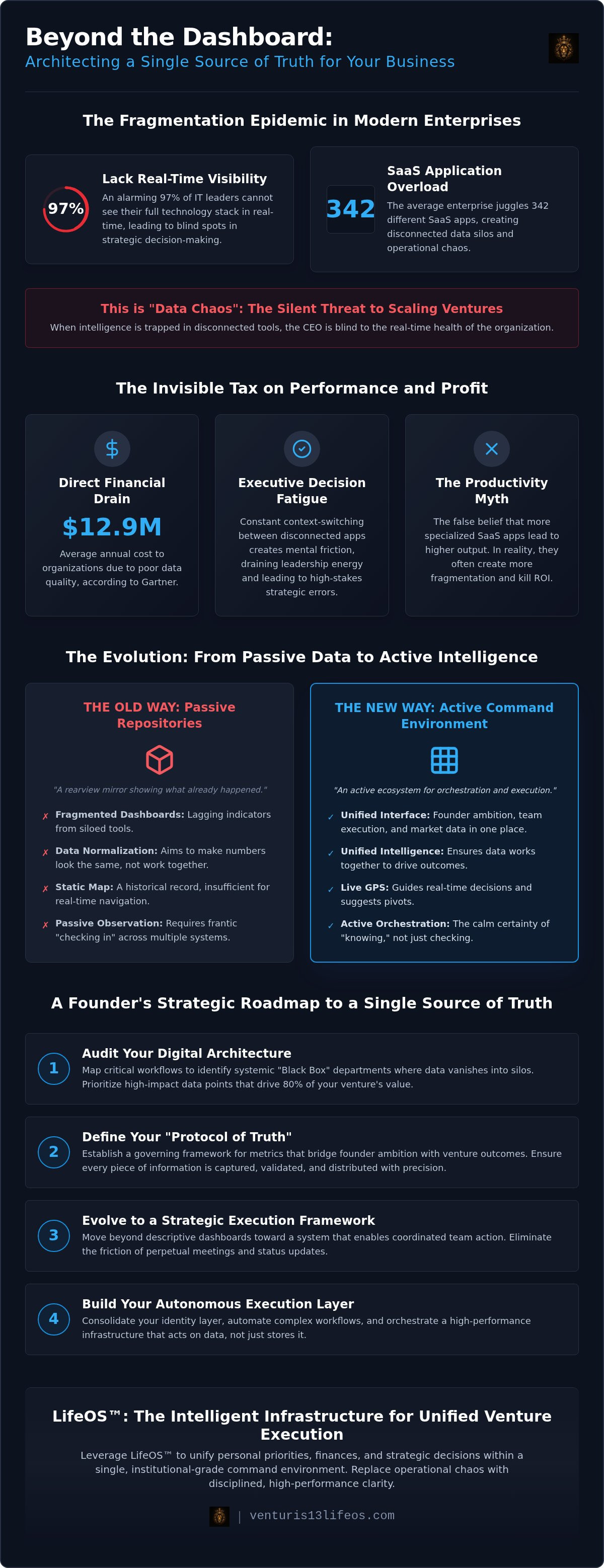
The average enterprise currently utilizes 342 SaaS applications, yet a staggering 97% of IT leaders lack real-time visibility into their own technology stack. This fragmentation isn't just a technical hurdle; it's a strategic poison. When your vision is scattered across disconnected apps, executive decision fatigue becomes inevitable. You find yourself managing tools instead of leading markets. To scale, you must move beyond these digital silos and establish a robust single source of truth for business strategy that acts as the silent engine of your venture.
We recognize the mental friction caused by the misalignment between your personal vision and team action. It's the primary barrier to high-performance leadership. This article provides the blueprint to architect a unified AI command environment that synchronizes founder ambition with venture execution. We'll explore the mechanics of integration, autonomy, and governance required to stabilize your growth. You'll learn how to reduce cognitive load, build scalable infrastructure, and transform passive data into active intelligence. It's time to replace operational chaos with disciplined, institutional-grade clarity.
Key Takeaways
- Establish a single source of truth for business strategy by transitioning from passive data normalization to an active, unified intelligence environment.
- Audit your digital architecture to identify systemic "Black Box" departments and define the metrics that bridge founder ambition with venture outcomes.
- Evolve beyond descriptive dashboards toward a framework of strategic execution, enabling coordinated team action while eliminating the friction of perpetual meetings.
- Follow a structured roadmap to consolidate your identity layer, automate complex workflows, and orchestrate high-performance venture infrastructure.
- Leverage LifeOS™ to unify personal priorities, finances, and strategic decisions within a single, institutional-grade command environment.
Table of Contents
- The Architecture of Truth: Defining SSOT in the AI Era
- How to Build a Unified Data Infrastructure for Strategic Decisions
- Beyond Dashboards: Transforming Fragmented Data into Coordinated Action
- Implementing the Command Center: A Founder’s Strategic Roadmap
- LifeOS™: The Intelligent Infrastructure for Unified Venture Execution
The Architecture of Truth: Defining SSOT in the AI Era
Architecture is not merely about storage; it's about orchestration, governance, and clarity. In the previous era of digital management, a Single Source of Truth (SSOT) was defined as a passive warehouse, a place where data was cleaned and stored for historical review. This approach is no longer sufficient. Today, a single source of truth for business strategy must function as a unified digital architecture for decision-making. It is the difference between a static map and a live GPS. While traditional "data normalization" seeks to make disparate numbers look the same, modern "unified intelligence" ensures those numbers actually work together to drive outcomes. In 2026, Data Chaos has emerged as the primary threat to scaling ventures. It is a silent, systemic rot that occurs when intelligence is trapped in disconnected silos, rendering the CEO blind to the real-time health of their organization.
We must distinguish between a simple dashboard and a true Command Environment. A dashboard is a rearview mirror; it displays what has already occurred, often through the lens of fragmented, lagging indicators. Conversely, a Command Environment is an active ecosystem. It unifies founder ambition, team execution, and market data into a single, cohesive interface. This transition from passive observation to active orchestration is the hallmark of a high-performance venture. It replaces the frantic energy of "checking in" with the calm, disciplined certainty of "knowing."
The High Cost of Fragmented Information
Mental friction is the invisible tax on executive energy. When a founder must bridge the gap between a marketing spreadsheet, a project management tool, and a financial ledger, cognitive load spikes. This fragmentation fuels the Productivity Myth, the false belief that more specialized SaaS applications lead to higher output. In reality, the average enterprise now juggles 342 SaaS applications, yet only 3% of IT leaders possess complete real-time visibility into their technology stack. This lack of transparency leads to high-stakes strategic errors. According to Gartner, poor data quality costs organizations an average of $12.9 million per year. These aren't just technical failures; they're leadership failures caused by a lack of structural integrity.
From Passive Repositories to Active Operating Systems
The evolution of business infrastructure is moving away from siloed SaaS tools toward integrated AI infrastructures. We are witnessing the rise of the Autonomous Execution Layer, a system that doesn't just store data but acts upon it. This layer identifies anomalies, suggests pivots, and automates complex workflows without requiring constant human intervention. It transforms the business from a collection of parts into a singular, high-performance machine. Unified data serves as the non-negotiable foundation for autonomous venture growth and institutional-grade scalability.
How to Build a Unified Data Infrastructure for Strategic Decisions
Architecture dictates behavior. To establish a single source of truth for business strategy, you must move beyond the superficial aggregation of spreadsheets and embrace a rigorous audit of your digital ecosystem. Most ventures operate with "Black Box" departments; sectors where data enters, vanishes into a silo, and never emerges as actionable intelligence. Building a unified infrastructure is not a technical task; it's a leadership mandate. It requires a Protocol of Truth, a governing framework that ensures every piece of information is captured, validated, and distributed with absolute precision. You don't need more storage; you need an environment that supports unified intelligence, bridging the gap between high-level ambition and ground-level execution.
Step 1: Mapping the Venture Execution Layer
Efficiency thrives on visibility. Your first objective is to identify the critical workflows that drive 80% of your venture’s value. Silos are the graveyard of strategic intent; they create friction, breed misalignment, and kill ROI. When your marketing data doesn't speak to your sales pipeline, or your product roadmap is disconnected from financial reality, execution falters. By mapping these layers, you can prioritize high-impact data points that actually move the needle. Utilizing AI for reducing executive decision fatigue allows you to offload the cognitive burden of sorting through noise, leaving you with the clarity required for decisive leadership.
- Expose hidden data silos in finance, operations, and growth.
- Quantify the cost of information delays on strategic pivots.
- Prioritize data streams that directly influence venture scalability.
Step 2: Integrating Personal and Professional Priorities
Traditional business systems fail because they ignore the human at the center. A founder’s personal identity, energy, and vision must be the root of the strategic system. If your venture execution is decoupled from your personal priorities, burnout is inevitable. We utilize the aligning personal priorities with business strategy framework to ensure that your daily actions are a direct reflection of your long-term legacy. This synchronization creates a "silent engine" of performance where personal growth and venture success are mutually reinforcing.
Establishing this single source of truth for business strategy means your health, finances, and ambitions are no longer competing for your attention. They are orchestrated within a single command environment. Architecting this level of synergy is the core promise of an AI Operating System designed for high-stakes leadership. It transforms fragmented life-management into a disciplined, institutional-grade infrastructure that scales as you do.
Beyond Dashboards: Transforming Fragmented Data into Coordinated Action
Strategic awareness is a luxury; strategic execution is a necessity. Many founders mistake "knowing what is happening" for "doing what is needed." You might possess a dashboard that tracks your churn rate, your burn rate, and your pipeline, but if that data doesn't trigger immediate, coordinated action, it's merely digital noise. A single source of truth for business strategy must evolve from a passive reporting tool into an active command environment. It bridges the gap between high-level ambition and ground-level execution, ensuring that every strategic insight is met with a systematic response. It is the difference between a map and a mission control center.
When intelligence is unified, the need for constant, exhausting status meetings evaporates. Coordinated team action becomes the default state. In this environment, AI acts as the connective tissue, translating grand visions into structured, autonomous workflows. It moves the organization away from the "Task Manager" model, which relies on human memory and manual updates, toward a "Command Center" model that operates with invisible efficiency. This transition reduces cognitive load for the CEO and provides the team with a clear, uncompromising blueprint for success.
The Fallacy of the "All-in-One" Productivity App
Generic productivity suites are often marketed as the ultimate solution for organizational clarity. They aren't. These platforms are essentially digital filing cabinets; they are excellent for storage but deficient in orchestration. They rely on linear project management, which treats work as a sequence of isolated checkboxes rather than an interconnected ecosystem. A true venture infrastructure requires a deeper level of system integration. Synchronizing personal performance and venture execution is impossible within a siloed app that treats your personal goals and your company's KPIs as separate entities. Without a unified core, you're simply managing lists, not building a scalable legacy.
Scaling Collective Intelligence with AI
Scalability is a function of cognitive offloading. In a high-stakes venture environment, the ability to offload routine decision-making to an intelligent system is what separates the visionary from the overwhelmed. A unified system allows for measurable progress by providing real-time feedback on strategic alignment. Unified data creates a "Single Source of Intent" for teams. When the intent is clear, the execution becomes disciplined, predictable, and hyper-competent. This collective intelligence ensures that the entire organization moves in unison, driven by a shared logic and a singular, unshakeable source of truth.
Implementing the Command Center: A Founder’s Strategic Roadmap
Architecture is destiny. To realize a single source of truth for business strategy, a founder must move beyond the haphazard adoption of tools and follow a rigorous, three-phase roadmap. This implementation is not a corporate IT rollout; it is a strategic metamorphosis. You are building an environment where ambition meets execution with mathematical precision. By following a structured path, you transform the frantic energy of a startup into the disciplined, high-performance output of a modern institution. It requires a commitment to order, a rejection of chaos, and a focus on long-term scalability.
Phase 1 begins with the Identity Layer. Here, you consolidate your personal vision, core values, and health into the business core, ensuring that the venture is an extension of your intent rather than a distraction from it. Phase 2 deploys the Execution Layer. In this stage, complex workflows, team coordination, and project milestones are automated into a seamless, self-correcting rhythm. Finally, Phase 3 establishes the Intelligence Layer. This is where AI synthesizes raw data into structured decisions, providing the foresight required for high-stakes maneuvers. Maintaining this system requires disciplined ambition and regular architectural audits to ensure the infrastructure remains robust as the venture scales.
Reducing Mental Friction through Systematic Order
Decision fatigue is the inevitable byproduct of poor architecture. When a CEO is forced to manage low-level tasks, strategic bandwidth is sacrificed. By offloading these micro-decisions to a dedicated system, you reclaim your mental energy for high-leverage activities that drive growth. Utilizing a founder operating system allows the venture to function as a silent engine, operating with invisible efficiency in the background. This systematic order provides the psychological safety needed to lead with clarity, conviction, and calm. You no longer react to the business; you orchestrate it.
Managing Multiple Ventures from a Single System
Clarity is the ultimate currency for the serial entrepreneur. Managing diverse interests requires a single source of truth for business strategy that spans across separate entities. Unified data enables cross-venture resource allocation, allowing you to see the aggregate health of your entire portfolio at a glance. You stop being a manager of individual tasks and become an architect of integrated systems. This bird's-eye view ensures that no venture is neglected and every strategic opportunity is captured. It allows for the seamless transfer of intelligence, capital, and talent across your entire ecosystem.
To begin your transition from manager to architect, explore the LifeOS Enterprise Plan and secure your strategic infrastructure today.
LifeOS™: The Intelligent Infrastructure for Unified Venture Execution
Strategic success is a function of structural integrity. LifeOS™ by Venturis 13 is the first category-defining AI Business and Life Infrastructure, designed to replace the fragmented chaos of legacy software with a unified command environment. It is the definitive single source of truth for business strategy, fusing personal finances, individual identity, and venture team coordination into a singular, intelligent ecosystem. This is not another productivity tool; it is an active operating system that synchronizes your highest ambitions with your daily execution. By centralizing intelligence, LifeOS™ acts as the silent engine that powers high-performance ventures toward institutional-grade scalability.
The LifeOS™ Enterprise Plan is engineered for the next generation of founders who manage complex, multi-faceted ventures. It provides the governance, orchestration, and automation required to scale intricate workflows without increasing cognitive load. Venturis 13 stands as the strategic partner for those who refuse to settle for fragmented data and disjointed leadership. We offer a blueprint for order, a framework for clarity, and a path toward the seamless fusion of intelligence and action. Launching in 2026, this infrastructure is built to support the weight of your most ambitious strategic goals.
Architecture for Ambitious Outcomes
Fragmented ambitions are transformed into structured, measurable decisions through the architectural precision of LifeOS™. While legacy software remains trapped in the "Task Manager" paradigm, our command environment operates as a true Operating System for your life and business. It provides real-time visibility into the metrics that matter most, allowing for rapid pivots and disciplined growth. We invite you to experience the clarity that comes from a unified single source of truth for business strategy, where every data point serves your long-term legacy. This is where your vision is translated into measurable progress, autonomy, and results.
Your Blueprint for Scalable Growth
The journey from data chaos to systematic excellence requires more than just better tools; it requires a superior philosophy of organization. We have explored the mechanics of building a unified data infrastructure, the transition from passive dashboards to active execution, and the roadmap for implementing a founder-centric command center. LifeOS™ is the culmination of this architectural vision. It provides the elite-level control required to navigate the complexities of modern venture management with calm and certainty. Upgrade your digital infrastructure and secure your strategic future by visiting the LifeOS landing page today.
Mastering the Command Environment
You don't need more tools; you need a better system. The transition from digital chaos to systematic excellence is a leadership mandate. We have established that a true single source of truth for business strategy is not a passive repository; it's an active, intelligent framework that unifies personal performance, venture outcomes, and market intelligence. By consolidating your identity, execution, and intelligence layers, you eliminate the mental friction that drains executive bandwidth. You move away from the frantic management of tasks and toward the calm orchestration of a high-performance machine.
It's time to deploy an institutional-grade venture infrastructure that operates with invisible efficiency. Through an AI-powered autonomous execution layer and a unified personal and professional command center, you can finally align your highest ambitions with measurable progress. This is the blueprint for order, clarity, and the elimination of mental friction. Architect your venture’s future with LifeOS™ and step into a new era of disciplined, scalable growth. The future belongs to those who lead with absolute architectural certainty.
Frequently Asked Questions
What is the difference between a database and a single source of truth?
A database is a passive repository of raw information, while a single source of truth for business strategy is an active, unified architecture designed for decision-making. Databases store data in isolation. An SSOT orchestrates that data, ensuring it's validated, integrated, and accessible across the entire venture ecosystem. It transforms static numbers into a live command environment where every metric serves a strategic purpose.
How does a single source of truth reduce executive decision fatigue?
Strategic clarity reduces executive decision fatigue by offloading the cognitive burden of data synthesis to an intelligent system. When your information is fragmented, you waste mental energy bridging gaps between disconnected apps. An integrated system provides real-time visibility, allowing you to focus on high-leverage activities rather than administrative noise. It acts as a silent engine, maintaining order and reducing the friction of leadership.
Can I build a single source of truth using legacy project management software?
Standard productivity tools are effective digital filing cabinets, but they lack the structural depth required for a true strategic source of truth. These platforms rely on linear project management and manual updates, which often lead to information silos and operational drift. They don't offer the autonomous execution or deep systems integration necessary to synchronize founder ambition with venture execution. To scale, you need an active operating system, not a passive task manager.
Why is unified data critical for scaling multiple business ventures?
Scaling multiple ventures requires a bird's-eye view of your entire portfolio, which is only possible through unified data. Without a single source of truth for business strategy, resource allocation becomes a matter of guesswork rather than logic. A unified system allows you to manage diverse interests from a single interface, ensuring cross-venture synergy and strategic oversight. It facilitates the transition from a manager of tasks to an architect of systems.
What role does AI play in maintaining a single source of truth for strategy?
AI serves as the autonomous execution layer that maintains the integrity and relevance of your strategic data. It doesn't just store information; it synthesizes it, identifies anomalies, and suggests strategic pivots. By translating high-level ambitions into structured workflows, AI ensures that your data remains an active asset. It provides the foresight required to navigate complex markets with mathematical precision and visionary confidence.
How do I align my personal goals with my business strategy in one system?
Alignment begins at the Identity Layer, where your personal vision, health, and finances are integrated into the business core. Traditional systems treat your life and your venture as separate entities, creating inevitable conflict and burnout. A unified intelligence infrastructure synchronizes these priorities, ensuring that every venture outcome reinforces your personal legacy. This synergy creates a disciplined rhythm where personal growth and business success are mutually inclusive.
What are the first steps to implementing a unified intelligence infrastructure?
Implementation starts with a rigorous audit of your existing digital architecture to expose systemic "Black Box" departments. You must identify where information is trapped and define the core metrics that bridge the gap between ambition and execution. Establishing a Protocol of Truth ensures that all incoming data is validated and integrated into the command environment. This methodical approach replaces operational chaos with a robust, institutional-grade infrastructure.
How does LifeOS™ differ from traditional project management software?
LifeOS™ by Venturis 13 is a category-defining AI Business and Life Infrastructure, moving beyond the limitations of legacy software. While traditional project management tools focus on passive task tracking, LifeOS™ functions as an active operating system for your entire life and venture. It unifies personal priorities with team execution in a single, intelligent command environment. It's designed for high-performance founders who require autonomy, governance, and seamless orchestration.