Integrated Personal and Business Financial Planning Software: Architecting Your Unified Command
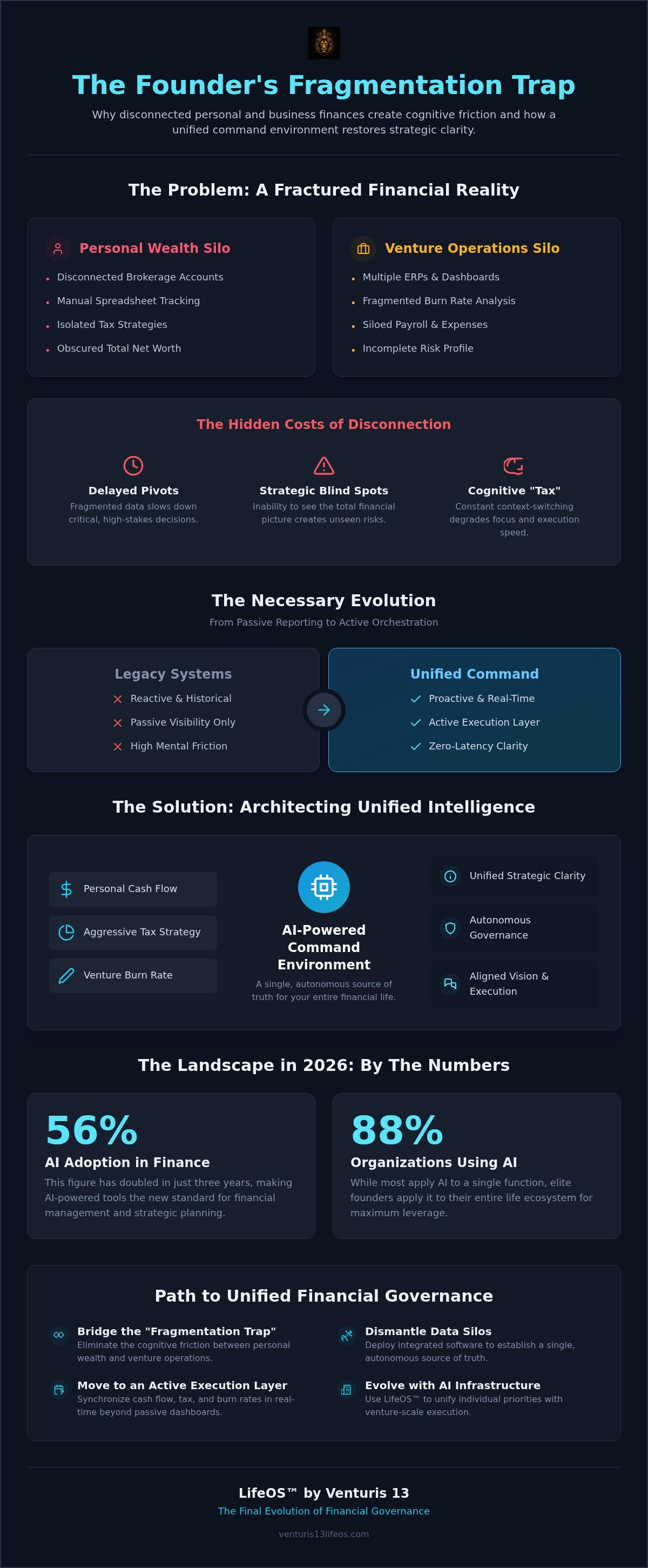
AI adoption in finance has reached 56% in 2026, doubling in just three years, yet most founders still operate within a fragmented landscape of disconnected spreadsheets, manual entries, and siloed accounts. Why are you managing your legacy and your burn rate as two separate entities? The friction caused by context-switching between personal wealth and venture execution is a tax on your cognitive bandwidth that you can no longer afford. To achieve true strategic clarity, you must transition toward integrated personal and business financial planning software that functions as a unified command environment. It is the only way to ensure your capital, your time, and your vision remain aligned.
You likely recognize the mental drain of fragmented data silos that delay critical decisions and obscure your total net worth. It's exhausting to hunt for a single source of truth across multiple dashboards while your venture demands rapid, high-stakes pivots. LifeOS™ by Venturis 13 represents the terminal evolution of this technology, positioning itself as a premium, essential infrastructure for the modern founder. This guide teaches you how to bridge the gap between personal wealth and venture execution by building a unified AI-powered financial command environment. We will explore the shift from passive tracking to active orchestration, the architecture of unified intelligence, and the path to achieving zero-latency strategic clarity for your entire life and business.
Key Takeaways
- Identify and bridge the "Fragmentation Trap," eliminating the cognitive friction that occurs when personal wealth and venture operations remain disconnected.
- Deploy integrated personal and business financial planning software to dismantle data silos and establish a single, autonomous source of truth for your total net worth.
- Move beyond passive dashboards toward an active execution layer that synchronizes personal cash flow, tax strategy, and venture burn rates in real-time.
- Learn the architectural steps to de-silo fragmented information, transforming manual spreadsheets into a high-performance stream of strategic intelligence.
- Evolve your financial governance with LifeOS™, an AI-powered infrastructure designed to unify individual priorities with venture-scale ambition and execution.
Table of Contents
- The Fragmentation Trap: Why Traditional Financial Software Fails Founders
- Architecting Unified Intelligence: Merging Personal and Business Flows
- Legacy ERPs vs. AI Operating Systems: A Strategic Comparison
- Step-by-Step: Building Your Unified Financial Command Environment
- Scaling Global Ambition with LifeOS™: The Final Evolution
The Fragmentation Trap: Why Traditional Financial Software Fails Founders
The "Fragmentation Trap" is the invisible barrier between your personal net worth and your venture's operational liquidity. For the modern founder, this gap is more than an inconvenience; it is a structural failure. Most entrepreneurs operate in a state of perpetual oscillation. They check personal brokerage accounts in one tab and scrutinize venture burn rates in another. This disconnect creates a lethal strategic blind spot. Without integrated personal and business financial planning software, your financial identity remains fractured, reactive, and inefficient.
The "Context-Switching Tax" is the heavy cognitive cost of this division. Every time you pivot between personal tax strategy and business payroll, your decision-making speed degrades. Fragmented data silos lead to delayed pivots, missed opportunities, and persistent mental friction. Traditional spreadsheets and legacy dashboards offer visibility, but visibility is not execution. They are passive artifacts of the past. To lead effectively in 2026, you must transition from these static tools toward a robust executive productivity infrastructure that unifies every financial stream into a single, coherent force.
The Hidden Cost of Data Silos
Data silos are the architects of strategic failure. When your personal assets and venture liabilities exist in separate ecosystems, you cannot accurately calculate your true risk profile or capital efficiency. This fragmentation creates "strategy gaps" where high-stakes decisions are made on incomplete intelligence. Managing multiple legal entities in isolation often leads to redundant SaaS expenses and overlapping service fees that erode your bottom line. A unified approach mirrors the principles of Integrated Business Planning (IBP), extending professional governance to the founder's entire life and portfolio.
Beyond Passive Reporting
A true command center must do more than report; it must execute. In a landscape where AI adoption in finance has reached 56%, relying on "seeing" data is no longer enough. You require a system that orchestrates action. Modern integrated personal and business financial planning software reduces mental friction by automating the categorization of complex workflows across personal and venture lines. It establishes a single source of truth, ensuring that your unified identity management is rooted in real-time accuracy rather than historical guesswork. This is the shift from passive observation to autonomous governance, discipline, and clarity.
Architecting Unified Intelligence: Merging Personal and Business Flows
Unified Intelligence represents the terminal evolution of financial management. It is the deliberate fusion of life priorities and venture execution. For the elite founder, capital isn't a static resource; it's a dynamic tool for both personal legacy and operational expansion. Achieving this requires integrated personal and business financial planning software that treats your entire financial footprint as a single, living organism. You must map the "Founder Core," where personal cash flow, aggressive tax strategy, and venture burn rates intersect to dictate your true strategic capacity.
This architectural approach transforms fragmented ambitions into structured, measurable outcomes. AI now plays the role of the lead orchestrator, synthesizing data across multiple industries and legal entities with a speed no human analyst can match. While 88% of organizations utilize AI in at least one business function, the visionary leader applies this intelligence to their entire life ecosystem. They ensure that every dollar spent in a venture serves a broader personal objective. It's about moving from passive thought to active, structured output.
The Core Identity Layer
The foundation of this command environment is the Core Identity Layer. It integrates your personal financial security with venture-scale risk management, creating a resilient buffer against market volatility. Utilizing AI for high-level venture control allows you to maintain an institutional grade of oversight while protecting your individual interests. This layer ensures your long-term legacy goals aren't compromised by short-term operational KPIs. Even traditional institutions recognize this necessity; for instance, the SBA Personal Financial Statement serves as a baseline requirement because it acknowledges that a founder's personal health is inseparable from their business's viability.
Real-Time Operational Clarity
Operational clarity is the antidote to strategic paralysis. You must move away from the archaic cycle of month-end reporting toward "Zero-Latency" strategic awareness. This involves normalizing data from diverse ventures into a single, high-fidelity executive view. By orchestrating these flows, you can predict personal liquidity needs based on upcoming venture milestones. This prevents you from being caught off guard by a capital call or a tax liability. Achieving this level of unified personal and venture intelligence is the hallmark of the modern strategic architect who values discipline and scalability.
Legacy ERPs vs. AI Operating Systems: A Strategic Comparison
Legacy Enterprise Resource Planning (ERP) systems represent a bygone era of architectural stagnation. They were designed for static corporations, not for the high-velocity founder managing a multi-venture portfolio. Rigidity, delay, and obsolescence are the hallmarks of these traditional frameworks. While they provide deep accounting functions, they fail to bridge the gap between corporate balance sheets and personal wealth. In 2026, the shift from fragmented apps to a unified operating system isn't just a trend. It's a strategic necessity for those who value zero-latency clarity and institutional-grade control.
The cost and scalability advantages of AI-native infrastructure are profound. Traditional systems demand massive upfront investment and perpetual maintenance, often requiring specialized consultants and long-term contracts that stifle agility. In contrast, an AI-powered execution layer offers autonomous orchestration of financial data at a fraction of the traditional overhead. This evolution explains why intelligent execution frameworks for founders are moving toward execution-first models. These systems don't just store information; they govern outcomes. For the modern entrepreneur, integrated personal and business financial planning software must function as a silent engine of growth, not a manual administrative burden.
The Rigidity of Traditional Multi-Entity Software
The "Implementation Gap" is the primary failure of legacy multi-entity software. These systems often take months to deploy, requiring extensive customization that is often obsolete by the time it's finished. High maintenance costs for custom financial dashboards further drain venture resources and focus. Most importantly, standard ERPs ignore the founder's personal identity. They treat personal tax strategy and venture burn rates as unrelated data points, forcing you back into the fragmentation trap. This separation prevents you from seeing the complete picture of your personal wealth, venture health, and strategic vision.
The Rise of the AI-Powered LifeOS™
LifeOS™ introduces "Infrastructure-as-a-System" for the elite performer. It represents a definitive transition from managing manual tasks to governing strategic outcomes. By utilizing integrated personal and business financial planning software, you replace manual data entry with autonomous governance and real-time synchronization. This isn't just about saving time; it's about eliminating the mental friction of reconciliation. The advantage goes to those who own their infrastructure. You don't need a passive record of the past; you need a system that drives your future. This is the difference between a dashboard and an operating system.
Step-by-Step: Building Your Unified Financial Command Environment
Constructing a unified command environment requires a transition from fragmented tracking to architectural governance. It is not a weekend project; it's a deliberate overhaul of how you interact with your capital and time. Mapping your total net worth while managing multi-venture burn rates is impossible without a structured blueprint. Deploying integrated personal and business financial planning software acts as the central nervous system for this new regime. It allows you to move from a state of reactive management to one of proactive orchestration, ensuring that your personal wealth and venture execution are never in conflict.
The transition starts by de-siloing information. You must shift from manual spreadsheets to autonomous data streams that feed into a singular execution layer. This process ensures that every decision is rooted in real-time accuracy rather than historical guesswork. By defining strategic KPIs that bridge personal health and venture success, you create a holistic view of your performance. This is how you achieve zero-latency strategic clarity, allowing you to decide, coordinate, and scale your entire life and business from one intelligent system.
Phase 1: The Infrastructure Audit
The first phase is a rigorous reconnaissance of your current data landscape. You must analyze, categorize, and secure every SaaS platform, bank account, and legal entity under your control. This audit identifies "Strategic Lever" metrics for each business unit, such as the relationship between venture liquidity and personal tax liability. Documenting access governance and security protocols is essential to maintain unified control without compromising safety. This phase establishes the baseline fidelity required for integrated personal and business financial planning software to function with institutional-grade precision.
Phase 2: Autonomous Orchestration
Once the infrastructure is audited, you move into autonomous orchestration. This involves setting up AI triggers to manage inter-company cash flows and automating routine decision-making. The goal is cognitive offloading; you want to remove the mental friction of reconciliation so you can focus on high-level governance. Structuring the command environment for maximum momentum requires a system that handles the "how" so you can dictate the "what." This transition from managing tasks to governing outcomes is the hallmark of the elite performer. To deploy this infrastructure without the burden of manual construction, explore how LifeOS™ unifies your personal and venture intelligence into a single, high-performance environment.
Scaling Global Ambition with LifeOS™: The Final Evolution
LifeOS™ represents the terminal point of financial and operational evolution. It's not merely a tool; it's a category-defining AI Business and Life Infrastructure. By unifying your personal identity with venture teams and strategic decisions, it finally closes the lethal gap between your wealth and your work. This system transforms fragmented information into a structured, intelligent command environment. When you deploy integrated personal and business financial planning software of this caliber, you gain the ability to scale multiple ventures with the speed and clarity of a single system. You move from the frantic energy of managing silos toward a state of calm, disciplined, and hyper-competent governance.
For founders navigating the highest levels of complexity, the LifeOS Enterprise Plan provides specialized infrastructure for coordinating intricate venture workflows. It is the silent engine that operates with invisible efficiency, allowing you to orchestrate resources across global markets without losing sight of your personal legacy. This is where your vision, your capital, and your execution layer finally merge into a single, high-performance machine. You no longer need to choose between personal security and venture-scale ambition; you now possess the blueprint to master both simultaneously.
The Unified Intelligence Advantage
Managing your life and business as a single, cohesive ecosystem is the ultimate competitive advantage. It ensures that every venture milestone aligns perfectly with your broader personal priorities. Through AI-driven alignment, you achieve a level of operational clarity that traditional dashboards simply cannot replicate. You require a system that understands your vision, anticipates your needs, and protects your interests across every entity you control. This is the essence of unified intelligence: the seamless fusion of individual ambition, strategic discipline, and institutional-grade execution.
Your Roadmap to Integrated Execution
The transition from fragmentation to total unified command is a strategic imperative for the modern elite performer. By adopting integrated personal and business financial planning software, you empower yourself to scale with greater speed and significantly less friction. You no longer waste cognitive bandwidth on reconciliation or context-switching. Instead, you focus entirely on high-level governance and visionary leadership. The path to this future is clear, structured, and inevitable for those who refuse to settle for legacy limitations. Take the final step toward institutional-grade clarity. Discover the LifeOS™ AI Operating System and claim your position at the center of your own unified command environment.
Command Your Future with Unified Governance
The era of managing your life and ventures in separate silos has reached its terminal point. You have identified the fragmentation trap that erodes strategic bandwidth. You have recognized how legacy systems fail to account for your personal identity. To lead with absolute authority, you require integrated personal and business financial planning software that functions as a single source of truth. This is the definitive transition from passive observation to active, structured output. It is the blueprint for total strategic clarity; it is the silent engine of your success.
LifeOS™ is the category-defining AI Business and Life Infrastructure designed for high-stakes venture execution. It unifies your personal and professional intelligence into a single, intelligent command environment. By orchestrating your total net worth and venture health within one system, you eliminate mental friction and accelerate your path to global ambition. The future belongs to those who value discipline, scalability, and the seamless fusion of intelligence and action. Step into the next generation of leadership and claim the clarity you deserve.
Architect Your Unified Infrastructure with LifeOS™
Frequently Asked Questions
What is integrated personal and business financial planning software?
This software is a unified intelligence environment that merges your personal wealth management with venture-scale operational data. It eliminates the fragmentation trap by providing a single source of truth for your total net worth and business burn rates. By using integrated personal and business financial planning software, you can bridge the gap between individual legacy goals and high-stakes venture execution within a single command layer.
Can I manage multiple companies in different industries from one unified system?
Yes, modern AI-powered systems are architected to normalize data across diverse sectors and legal entities. This structure allows you to maintain institutional-grade oversight of various ventures while ensuring your personal liquidity remains optimized. It provides a cohesive executive view that ignores industry silos, focusing instead on the global orchestration of your capital and strategic vision.
How does AI improve financial decision-making for founders?
AI transforms passive data into active intelligence by automating transaction categorization and predictive cash flow analysis. With AI adoption in finance reaching 56% in 2026, founders use these systems to achieve zero-latency strategic clarity. It eliminates the mental friction of manual reconciliation, allowing you to focus on high-level governance and the seamless fusion of intelligence and action.
Is it secure to integrate personal financial data with business venture data?
Security is the foundational bedrock of unified intelligence. High-end systems utilize bank-level encryption and robust access governance protocols to protect your sensitive data landscape. This ensures that while your strategic intelligence is unified, your legal and security boundaries remain strictly enforced. You gain the advantage of total visibility without compromising the integrity of your individual or corporate assets.
What is the difference between a financial dashboard and an AI operating system?
A dashboard is a passive reporting tool that merely displays historical snapshots and static data points. An AI operating system like LifeOS™ is an active execution layer that orchestrates data, coordinates workflows, and drives structured outcomes. It functions as a silent engine of growth, moving beyond simple visualization toward the autonomous governance of your entire financial life.
Do I need to replace my existing accounting software to use LifeOS™?
No, LifeOS™ functions as a superior orchestration layer that unifies data from your existing ERPs, bank accounts, and brokerage platforms. It doesn't replace your ledger; it transforms fragmented accounting data into a high-performance command environment. This allows you to maintain your current accounting workflows while gaining a sophisticated execution layer for multi-venture decision-making.
How does linking personal performance to business execution help scale ventures?
It aligns your individual risk tolerance with venture-scale growth strategies. When you understand your total capital efficiency through integrated personal and business financial planning software, you can make bolder strategic pivots. This alignment ensures you don't compromise your long-term personal legacy while pursuing aggressive expansion, providing the confidence needed to scale at a global level.
What are the primary benefits of an AI-powered command environment for serial entrepreneurs?
The primary benefits include cognitive offloading, zero-latency clarity, and the total elimination of the context-switching tax. This specialized infrastructure allows you to govern complex venture portfolios with the same ease as a single entity. It fosters a calm, disciplined, and hyper-competent emotional state by removing the frantic energy typically associated with managing disconnected financial silos.