Linear Alternatives for Venture Management: Why Strategic Leaders Need Tara and an AI Operating System in 2026
Your venture is not a software bug, so why are you managing its future in a technical issue tracker? Traditional project tools offer a false sense of order while burying your strategic vision under a mountain of fragmented tickets, status updates, and technical debt. As global venture funding reached a record $510 billion in the first half of 2026, the gap between simple task management and true venture orchestration has become a chasm. Searching for Linear alternatives for venture management is no longer a tactical choice. It is a strategic necessity for leaders who value complexity, clarity, and control. You require a system that understands the nuance of business logic, the weight of capital allocation, and the precision of institutional governance.
We recognize the mental friction inherent in switching between personal priorities and venture execution across a dozen disconnected applications. You deserve a unified command center that transforms fragmented data into structured decisions and measurable progress. This article explores the evolution from passive tracking to active orchestration through LifeOS™ by Venturis 13. You will learn how to eliminate cognitive load, bridge the divide between life and business, and deploy a robust infrastructure designed for the high-stakes reality of the modern economy.
Key Takeaways
- Identify the "issue-centric" fallacy of developer-first tools and why treating ventures as a series of software bugs obscures strategic vision and high-level decision-making.
- Explore the most effective Linear alternatives for venture management that prioritize architectural depth, institutional governance, and autonomous execution over simple task tracking.
- Transition from fragmented SaaS applications to a unified AI operating system that orchestrates personal priorities, financial data, and venture workflows within a single, coherent environment.
- Implement a command center philosophy to eliminate mental friction, offload cognitive complexity, and ensure every tactical action leads to measurable, strategic progress.
Table of Contents
- The Linear Trap: Why Engineering Tools Fail Strategic Venture Management
- Beyond SaaS: The Shift to AI-Powered Venture Infrastructure
- Comparing Linear Alternatives: SaaS Productivity vs. LifeOS™ Architecture
- Architecture Over Apps: Designing Your Unified Venture Command Center
- LifeOS™: The Intelligent Alternative for High-Stakes Venture Orchestration
The Linear Trap: Why Engineering Tools Fail Strategic Venture Management
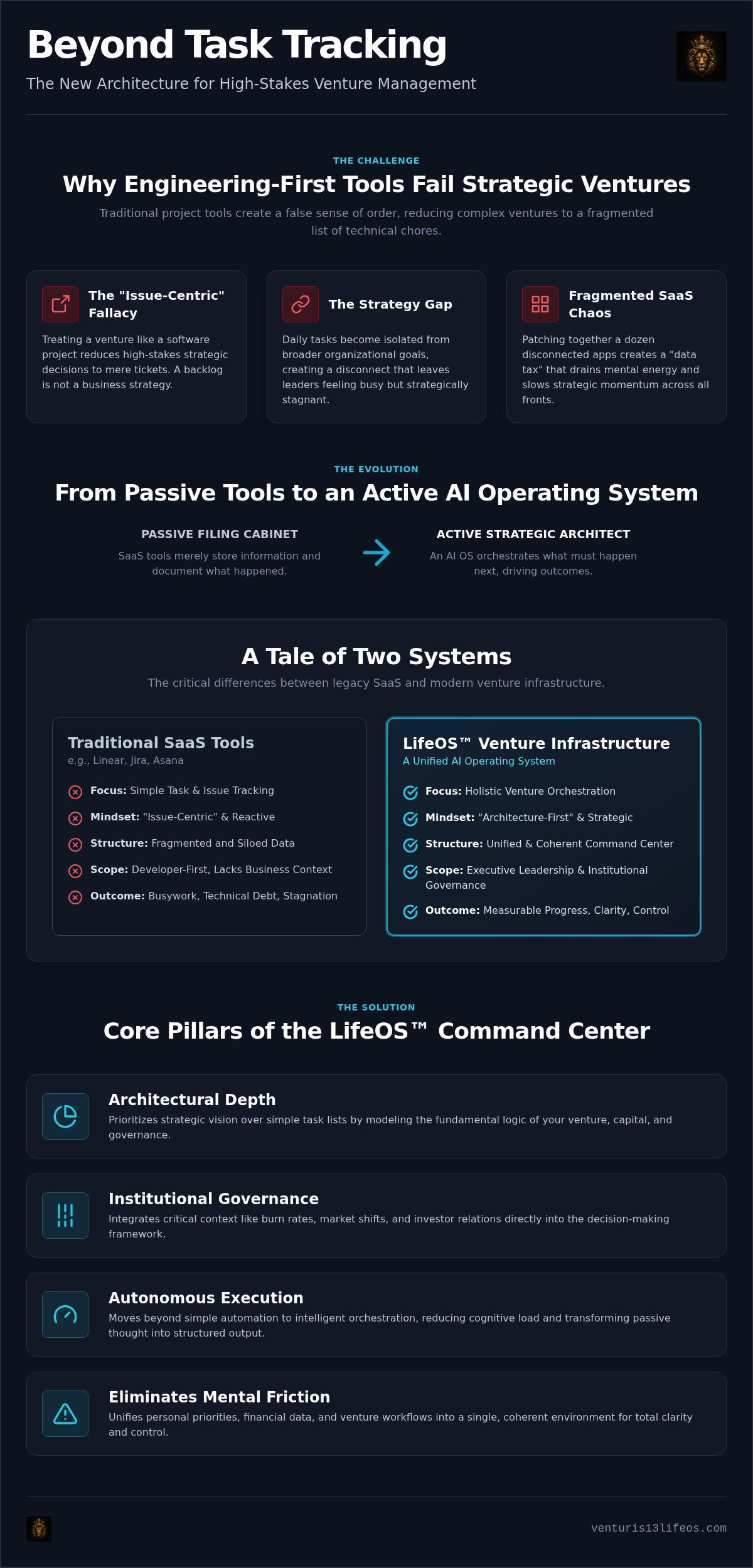
Your venture is not a sequence of software bugs. It is a complex, living entity that requires vision, capital, and governance to thrive. When leaders rely on engineering tools like Linear to manage a business, they fall into the "Issue-Centric" Fallacy. This mindset reduces high-stakes strategic decisions to mere tickets. It prioritizes the "what" over the "why" and the "how." For those seeking Linear alternatives for venture management, the realization is clear: a backlog is not a strategy. It is merely a list of chores that often distracts from the architectural vision required to scale. This technical overhead creates a silent tax on non-technical founders, forcing them to navigate developer-first interfaces that offer zero insight into the strategic pulse of the company.
Standard project tools fail because they lack integrated strategic management frameworks. They isolate daily tasks from the broader goals of the organization, creating a Strategy Gap that leaves leaders feeling busy but stagnant. This disconnect often leads to a fragmented identity where personal priorities, financial health, and venture execution exist in separate, warring silos. To lead with clarity, discipline, and hyper-competence, you must move beyond the limitations of simple task-based software.
The Limits of the Developer Mindset in Executive Leadership
Velocity in coding measures how fast a team ships features. It does not measure how effectively a venture scales. In the high-stakes environment of 2026, speed without direction is merely a faster path to failure. Managing a business through a Jira-lite interface creates a psychological friction that drains executive energy and muddies the decision-making process. The Strategic Strategy Gap is the distance between ambition and structured execution. Bridging this gap requires a system built for orchestration rather than just documentation.
Linear for Non-Technical Venture Management: A Square Peg in a Round Hole
Standard issue trackers provide no financial or strategic context. They don't account for burn rates, market shifts, or investor relations. Founders require decision support, not just ticket management. The transition from tracking work to governing a venture necessitates a shift toward more robust Linear alternatives for venture management. You need an environment that facilitates governance, provides total clarity, and ensures institutional-grade coordination. By moving from "tracking work" to "governing a venture," you reclaim your time and focus for the decisions that actually move the needle.
Beyond SaaS: The Shift to AI-Powered Venture Infrastructure
The traditional SaaS model is reaching its logical limit. For years, founders have patched together disparate applications, hoping that more tools would lead to more clarity. Instead, this fragmentation has created a "data tax" that drains mental energy and slows strategic momentum. True AI in venture building requires more than just a faster interface or a prettier task list. It demands a fundamental shift toward Venture Infrastructure. This is the underlying AI environment that unifies data, decisions, and team action into a single, cohesive engine. It represents the evolution from passive software that merely stores information to active, intelligent operating systems that drive outcomes.
While legacy tools act as digital filing cabinets, an AI operating system functions as a strategic architect. It doesn't just record what happened; it orchestrates what must happen next. This distinction between orchestration and automation is critical. Automation follows simple, rigid triggers. Orchestration uses intelligence to navigate complexity, manage resources, and align daily tasks with long-term governance. For leaders evaluating Linear alternatives for venture management, the choice is no longer about which app has the better UI. It is about which system provides the most robust Autonomous Execution Layer to reduce cognitive load and accelerate growth. This layer acts as a silent engine, operating with invisible efficiency to transform passive thought into structured output.
What is an AI Operating System for Ventures?
An AI Operating System is not a glorified chatbot. It is a comprehensive architecture designed to understand the specific DNA of your business. It rests on three foundational pillars: Unified Data, Strategic Alignment, and Coordinated Action. By integrating these elements, the system eliminates the friction between "life" and "venture." It treats your personal priorities, financial health, and business milestones as a single, coherent system. This holistic approach ensures that every decision is backed by the full context of your enterprise, allowing you to move from reactive management to proactive leadership.
Why 2026 is the Year of the Autonomous Execution Layer
In 2026, the era of manual data entry and repetitive workflow setup is over. We have entered the age of AI-driven workflow synthesis. Modern executive productivity infrastructure is now the standard for those who manage multiple high-stakes projects simultaneously. This infrastructure replaces the traditional, cluttered tech stack with a streamlined, institutional-grade environment. Serial entrepreneurs are increasingly turning to Linear alternatives for venture management that offer autonomous layers capable of handling the "how" so the leader can focus entirely on the "why." If you are ready to evolve your execution, exploring a unified venture intelligence platform is the necessary next step for strategic growth.
Comparing Linear Alternatives: SaaS Productivity vs. LifeOS™ Architecture
Standard productivity software operates on a surface level. It tracks actions, logs hours, and sends alerts. For a developer, this granularity is essential. For a strategic leader, it is a source of profound mental friction. When evaluating Linear alternatives for venture management, the distinction between a productivity app and an operating system becomes the primary driver of executive success. You don't need another list. You need a system that thinks, organizes, and executes alongside you. While Linear excels at tracking software bugs, it lacks the architectural depth to manage the financial, personal, and strategic layers of a growing venture.
The transition from a tool to an infrastructure is a move toward hyper-competence. It is the difference between working inside a machine and owning the engine. Traditional tools like Asana and Linear are designed for task completion, yet they offer no support for decision-making or strategic governance. They require you to be the intelligence that connects the dots. In contrast, an AI operating system provides the connective tissue, transforming fragmented tasks into a unified vision for venture scaling. This reduces cognitive load, eliminates redundant input, and ensures that your mental energy is reserved for high-stakes leadership.
The SaaS Productivity Ceiling
Legacy project management suites often lead to notification fatigue. They bombard users with alerts that lack context, priority, or strategic relevance. This is the inevitable result of flat data structures that treat a grocery list with the same weight as a board meeting preparation. High-performance leaders require a hierarchical, intelligent approach to data. Implementing AI for multi-venture portfolio management solves this complexity problem by introducing a layer of strategic filtration. It ensures that only the most critical information reaches the executive level, maintaining a state of calm, disciplined focus.
LifeOS™ vs. The Field: A Strategic Breakdown
The core advantage of LifeOS™ is unified intelligence. Most Linear alternatives for venture management ignore the founder's personal identity and priorities. They assume your business exists in a vacuum. LifeOS™ recognizes that a venture is an extension of the leader's life, integrating personal finances, health, and goals into the venture workflow. Instead of a per-seat pricing model that encourages bloat, we offer infrastructure-grade value that scales with your ambition. This is not just a tool for your team; it is an intelligent partner for your entire enterprise, providing the clarity needed to navigate the complexities of 2026.
Architecture Over Apps: Designing Your Unified Venture Command Center
Venture management is an architectural challenge, not a software problem. Most founders treat their tech stack like a collection of isolated tools, yet they wonder why their attention feels fragmented. True leadership requires a command center that centralizes vision, execution, and oversight into a single, high-performance environment. When investigating Linear alternatives for venture management, founders often discover that flexibility without structure is merely another form of chaos. Unlike sandboxes that require endless manual building, a command center provides the blueprint for institutional-grade governance. It moves you away from the frantic energy of "doing" and into the calm, disciplined state of "orchestrating."
This architectural shift is about more than just organization. It is about the seamless fusion of intelligence and action. By designing a system that mirrors your strategic logic, you eliminate the mental friction of context switching. You no longer search for information; information finds you through an intelligent infrastructure that understands your objectives. This is the transition from passive data storage to an active, silent engine that drives venture progress with invisible efficiency.
The Blueprint for a Unified Command Environment
A unified command environment maps your strategic workflows to an intelligent infrastructure. It ensures that every milestone is connected to the capital, resources, and team actions required for its realization. Implementing LifeOS allows you to transform fragmented ambitions into structured outcomes through a robust, AI-driven framework. Cognitive offloading directly increases strategic speed by liberating executive bandwidth for high-leverage decision-making. By delegating the organizational overhead to your AI operating system, you maintain the clarity needed to navigate the complexities of 2026.
Managing Multiple Ventures Without Burnout
Serial entrepreneurs often face a "complexity tax" that leads to burnout. Managing multiple ventures requires a "Single Pane of Glass" approach to governance, where every project is visible but none are overwhelming. This coordination happens through unified intelligence rather than constant meetings or status updates. You must integrate your personal finances, wellness, and identity within the venture execution framework to ensure peak performance. When your personal and professional priorities are orchestrated as a single system, you achieve a state of hyper-competence that typical Linear alternatives for venture management simply cannot provide. If you are ready to design your own strategic blueprint, explore the LifeOS venture architecture to begin your transition to unified intelligence.
LifeOS™: The Intelligent Alternative for High-Stakes Venture Orchestration
LifeOS™ represents the definitive resolution for leaders who have exhausted the utility of engineering-centric trackers. It is the architectural answer to the "Linear Trap" identified earlier in this analysis. While other Linear alternatives for venture management attempt to refine the interface of the task list, LifeOS™ replaces the list entirely with a unified intelligence engine. This is the logical conclusion for the strategic architect. By moving beyond the fragmented nature of traditional SaaS, you embrace a system that unifies personal priorities, venture capital, and strategic execution into a single, high-performance ecosystem. It is designed to transform fragmented information into coordinated, measurable progress, ensuring that your mental energy is reserved for the decisions that define your legacy.
Clarity, speed, and scalable outcomes are no longer aspirational goals. They are the standard operating results of a correctly configured AI operating system. LifeOS™ provides the infrastructure to analyze, align, and accelerate your ventures with institutional-grade precision. It functions as a silent engine of efficiency, operating with invisible competence to bridge the gap between your highest ambitions and your daily tactical output. In the high-stakes environment of 2026, this level of integration is not a luxury. It is the foundational requirement for those who intend to lead rather than merely manage.
LifeOS™ Enterprise: Scaling Collective Intelligence
The LifeOS™ Enterprise Plan offers more than a collaborative workspace. It delivers a robust environment where collective intelligence is harvested, refined, and deployed across entire venture teams. This is infrastructure for venture teams that goes beyond simple collaboration, providing strategic decision-making tools specifically engineered for boards and executives. By integrating sovereign governance with venture execution, the system ensures that every motion serves the overarching strategic intent. The future of venture management is autonomous, integrated, and intelligent. It is a world where your infrastructure understands your goals as well as you do, providing the governance needed to scale without the friction of manual oversight.
Take Command of Your Venture Future
Founders in 2026 cannot afford to manage high-stakes ventures with yesterday’s tools. The transition from fragmented SaaS to a unified AI operating system is the most significant competitive advantage available to the modern entrepreneur. You must choose between the frantic energy of disconnected apps and the calm, disciplined power of a unified command center. Reclaim your focus. Eliminate the strategy gap. Deploy a system that operates at the speed of your ambition. Your venture deserves an architecture that matches its potential. Secure your Venture Infrastructure with LifeOS™ and begin the transition to a unified, intelligent future today.
Command Your Strategic Architecture
The transition from technical issue trackers to a unified AI operating system is the definitive move for the strategic elite. You've seen how fragmented tools create a strategy gap that obscures vision, drains energy, and stalls momentum. By adopting robust Linear alternatives for venture management, you replace the frantic noise of developer-first backlogs with a silent engine of efficiency. This shift unifies your personal identity, financial health, and venture workflows into a single, institutional-grade environment. It represents the essential evolution from passive thought to active, structured output.
The future belongs to leaders who prioritize architecture over apps and orchestration over manual labor. You require a system designed for high-stakes venture environments, featuring an AI-powered autonomous execution layer that transforms data into measurable progress. This is your blueprint for hyper-competence in 2026. It's time to move beyond the limitations of yesterday's tech stack and embrace the certainty of unified intelligence. The era of the fragmented founder is over; the era of the integrated architect has begun.
Architect your venture's future with LifeOS™
Step into the calm, disciplined state of total control and lead with the visionary confidence your venture deserves.
Frequently Asked Questions
Is Linear good for non-technical project management?
Linear is optimized for software engineering workflows and technical issue tracking, which makes it a poor fit for strategic venture management. Non-technical leaders often find that its developer-first logic forces them to treat every business decision as a technical ticket. This creates unnecessary overhead and obscures the high-level governance required to lead an organization with clarity, discipline, and vision.
What makes LifeOS™ different from traditional project management software like Asana?
Traditional project management software focuses on task completion and notification volume, whereas LifeOS™ provides a unified AI infrastructure for venture execution. It functions as an intelligent partner that unifies your personal priorities, financial data, and business milestones. Instead of merely recording what happened, LifeOS™ orchestrates what must happen next through autonomous execution, strategic alignment, and institutional governance.
Can I manage multiple business ventures in one system?
You can manage multiple business ventures within a single LifeOS™ environment without experiencing cognitive overload or mental friction. The system utilizes a "Single Pane of Glass" architecture to provide total clarity across complex portfolios. This allows serial entrepreneurs to coordinate diverse teams, track capital allocation, and maintain strategic oversight from a centralized, high-performance command center.
What is an AI Operating System for business?
An AI Operating System is a category-defining infrastructure that unifies data, decisions, and team action into a single, cohesive engine. It represents the evolution from passive SaaS applications to active, intelligent environments. These systems move beyond simple automation to provide orchestration, governance, and autonomous execution layers that drive venture outcomes with invisible efficiency and architectural precision.
How does unified intelligence reduce mental friction for founders?
Unified intelligence reduces mental friction by eliminating the need to switch between disconnected applications for personal and professional tasks. By integrating your identity, finances, and ventures, the system provides a holistic context for every decision you make. This reduces cognitive load, minimizes redundant input, and ensures that your mental energy is reserved for high-stakes leadership and strategic growth.
Is LifeOS™ suitable for enterprise-level venture teams?
LifeOS™ is specifically engineered for enterprise-level venture teams that require institutional-grade coordination and strategic speed. The Enterprise Plan offers advanced decision-making tools for boards and executives, ensuring that collective intelligence is harvested and deployed across the entire organization. It provides the robust governance, scalability, and security needed to manage complex, high-stakes venture environments in 2026.
What are the best Linear alternatives for founders in 2026?
The best Linear alternatives for venture management in 2026 are those that prioritize architectural depth and AI orchestration over simple task lists. While legacy productivity suites offer basic project tracking, LifeOS™ stands as the premier institutional-grade alternative. It is designed for founders who have outgrown developer-centric tools and require a unified command center for life and business.
How do I transition from Linear to a more strategic management system?
Transitioning from Linear involves shifting your perspective from "tracking work" to "governing a venture." You must map your strategic workflows to an intelligent infrastructure that understands business logic rather than just software bugs. By deploying Linear alternatives for venture management like LifeOS™, you can migrate your existing data into a system that prioritizes strategic alignment, financial context, and autonomous execution.