ROI of an AI OS for Ventures: How Tara Maximizes Enterprise Returns
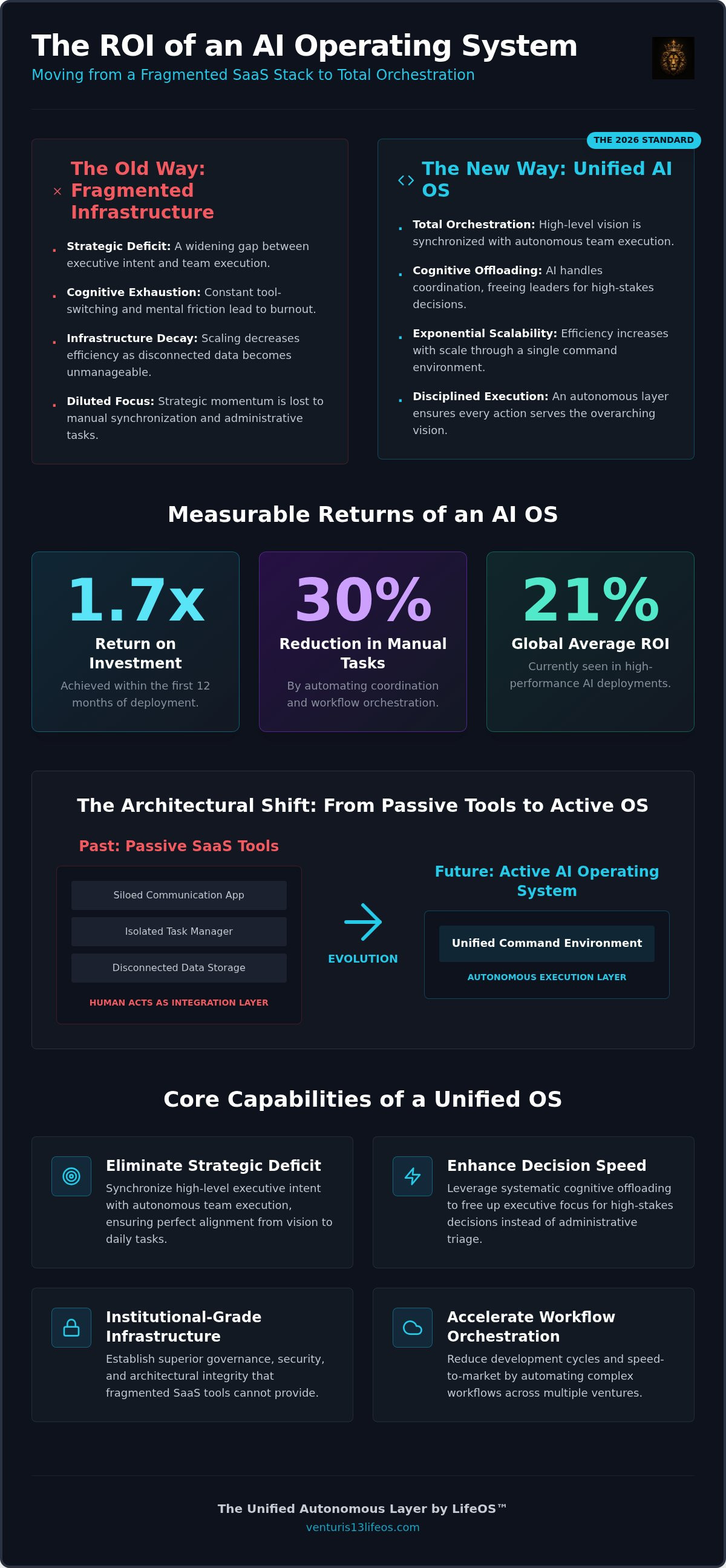
The era of the fragmented SaaS stack is over; it's a relic of a disconnected past that breeds cognitive exhaustion and strategic drift. While the average organization has automated 30 percent of its tasks as of 2026, most executives remain trapped in a cycle of tool-switching and mental friction. You likely recognize the cost of this fragmentation: the loss of intent, the dilution of focus, and the persistent weight of burnout. Transitioning to a unified autonomous layer, such as LifeOS™ by Venturis 13, is no longer an experimental luxury. It's a structural necessity. By understanding the measurable ROI of an AI operating system for ventures, you can move beyond simple efficiency toward a state of total orchestration.
We agree that managing multiple ventures requires more than just better software; it demands a singular, intelligent command environment like LifeOS™ by Venturis 13. This guide provides the framework to quantify the strategic, operational, and financial returns of such a transition, including the 21 percent global average ROI currently seen in high-performance AI deployments. You'll learn how to replace fragmented execution with a disciplined system that preserves cognitive capital and accelerates decision-making. We will examine the specific mechanics of agentic AI, the benchmarks for enterprise scalability, and the roadmap for achieving a 1.7x return on your initial investment within the first year.
Key Takeaways
- Identify and eliminate the strategic deficit by synchronizing high-level executive intent with autonomous team execution.
- Calculate the tangible ROI of an AI operating system for ventures through measurable labor cost reductions and accelerated workflow orchestration.
- Enhance decision speed and executive performance by leveraging systematic cognitive offloading within a unified command environment.
- Establish institutional-grade infrastructure that provides superior governance, security, and architectural integrity over fragmented SaaS tools.
- Deploy the 2026 transition framework to minimize time-to-value and ensure a disciplined, scalable evolution of your venture infrastructure.
Table of Contents
- The Strategic Deficit: Why Traditional Infrastructure Erodes Venture ROI
- Quantifying Hard ROI: Labor, Speed, and Autonomous Execution
- Soft ROI: Cognitive Offloading and High-Stakes Decision Speed
- Institutional Grade Infrastructure: Comparing the Enterprise Standard
- Operationalizing ROI: Deploying the LifeOS Enterprise Infrastructure
The Strategic Deficit: Why Traditional Infrastructure Erodes Venture ROI
Venture success in 2026 depends on the precision of execution, yet most organizations suffer from a widening Strategic Deficit. This deficit is the measurable gap between executive intent and team execution, where high-level vision dissolves into a chaotic sea of disconnected tasks. When a founder’s strategic clarity fails to reach the operational front lines, the resulting misalignment acts as a silent drain on capital. Traditional infrastructure, built on a patchwork of legacy applications, cannot bridge this divide. It merely documents the failure to align.
Fragmented SaaS ecosystems impose a heavy tax on venture speed. Every additional tool introduces a layer of complexity, requiring constant manual synchronization that dilutes strategic momentum. This friction is not merely an inconvenience; it's a structural flaw that erodes the very foundation for integrated intelligence, a need profoundly highlighted by the current AI boom. Linear project management for strategic leaders is now insufficient for multi-venture environments. Static boards and Gantt charts are reactive, lagging behind the real-time velocity required to maintain a competitive edge. Without a unified layer, ventures face Infrastructure Decay, a state where scaling actually decreases efficiency as the weight of disconnected data becomes unmanageable.
The Hidden Cost of Disconnected Tools
Context switching is the primary killer of executive focus. When data is siloed across disparate platforms, founders pay a mental friction tax that depletes their cognitive reserves. Strategic data degrades when it exists in isolation; a decision made in a communication app rarely informs the execution in a task manager. This fragmentation forces the human brain to act as the primary integration layer, leading to burnout and lost opportunities. The ROI of an AI operating system for ventures is found in the elimination of this manual overhead, allowing leaders to reclaim their time for high-stakes decision-making rather than administrative triage.
From SaaS to OS: The Architectural Shift
The transition from passive tools to an active operating system represents a fundamental architectural evolution. Traditional SaaS is passive; it waits for human input to move data from point A to point B. In contrast, an AI operating system functions as an autonomous execution layer that anticipates needs, orchestrates workflows, and maintains strategic alignment without constant intervention. Moving to a unified LifeOS™ by Venturis 13 ensures that every action taken across multiple entities serves the overarching vision. By consolidating intelligence into a single command environment, you replace the frantic energy of "doing" with the disciplined power of "orchestrating," directly impacting the bottom line through superior operational governance.
Quantifying Hard ROI: Labor, Speed, and Autonomous Execution
Hard ROI is no longer a projection; it's a structural reality. Calculating the ROI of an AI operating system for ventures requires a shift from measuring individual tasks to measuring systemic output. In 2026, organizations implementing advanced AI infrastructure achieve an average ROI of 1.7 times their initial investment. This return is driven by a 30 percent reduction in manual coordination and a collapse of traditional development cycles. By automating the alignment of team actions with executive intent, the Enterprise Plan eliminates the "strategic drag" that typically hampers rapidly scaling entities. The hard ROI of an AI operating system for ventures in 2026 is defined by a 1.7x return on initial investment and a 30 percent reduction in manual coordination tasks within the first twelve months of deployment.
Venture valuation is increasingly tied to execution speed. Reduced development cycles and faster speed-to-market directly influence exit multiples. When teams operate within a unified autonomous layer, they achieve more with a leaner, more coordinated headcount. This efficiency gain allows capital to be deployed toward innovation rather than administrative maintenance. It's a fundamental move from linear growth to exponential scalability.
The Autonomous Execution Layer as a Value Driver
Autonomous execution offloads the burden of routine strategic coordination from human managers. This system functions as a silent engine, managing the governance of workflows without requiring constant oversight. By reducing "work about work," leaders reclaim dozens of hours each month. Real-time execution data replaces delayed manual reporting, providing a high-fidelity view of venture health. This architectural clarity ensures that every dollar spent on labor is maximized for strategic impact. To see how these systems integrate with your current model, consider the LifeOS Enterprise Plan as your primary execution lever.
Scaling Multi-Venture Workflows
Managing three or more ventures from a single intelligent command environment creates a massive scalability advantage. Traditional models require duplicating management layers for every new entity, which is both expensive and inefficient. The Enterprise Plan breaks this cycle by providing a standardized executive productivity infrastructure that serves as a foundation for all ventures. This shared intelligence layer reduces the cost of launching subsequent ventures, as the operational blueprint is already established. You aren't just building businesses; you're operating a high-performance machine that scales with mathematical precision.
Soft ROI: Cognitive Offloading and High-Stakes Decision Speed
Soft returns are often dismissed as qualitative; they're actually the cognitive foundation for all hard gains. In high-stakes venture environments, the most valuable asset isn't capital. It's the founder’s attention. Cognitive offloading refers to the systematic transfer of data management and routine coordination from the human mind to an autonomous infrastructure. This transfer eliminates the mental friction inherent in managing multiple entities. By securing this intangible capital, the ROI of an AI operating system for ventures becomes visible through sustained executive performance and superior decision speed.
Decision speed is a critical competitive lever. When a venture leader can access, analyze, and act upon integrated data in seconds rather than hours, the market advantage is absolute. This acceleration prevents strategic drift and ensures that the initial vision remains intact through every phase of execution. Furthermore, the alignment of personal identity with professional output creates a unified sense of purpose. This synergy reduces the risk of executive burnout, ensuring that the venture’s leadership remains operational, focused, and disciplined for the long term.
Reducing Mental Friction for Venture Leaders
Hyper-competence is the result of integration. By deploying the "Silent Engine" of LifeOS™, leaders move away from the frantic energy of tool-switching toward a state of calm, architectural control. This system preserves executive focus for high-leverage tasks: capital allocation, strategic partnerships, and visionary design. The long-term ROI of an AI operating system for ventures is found in this sustained longevity. It's the difference between a founder who scales for a season and one who builds an enduring legacy across multiple decades.
Unified Intelligence for Strategic Clarity
Strategic clarity requires a single source of truth. Fragmented systems create "hallucinations" of progress where teams move quickly in the wrong direction. By implementing the architecture of unified intelligence, you ensure that every strategic choice is informed by the totality of your data. This unified environment provides several key advantages:
- Global Alignment: Distributed venture teams operate with a shared mental model, reducing the need for constant, redundant meetings.
- Data Integrity: Personal priorities and venture milestones exist in one ecosystem, preventing the "strategic leakage" that occurs when life and work are siloed.
- Predictive Governance: The system identifies potential bottlenecks before they manifest as operational failures, allowing for proactive correction.
This level of orchestration transforms the venture from a collection of projects into a singular, high-performance organism. You don't just manage ventures; you command an ecosystem where intelligence and action are seamlessly fused.
Institutional Grade Infrastructure: Comparing the Enterprise Standard
True venture scalability requires more than just a collection of productivity tools; it demands an architectural foundation that supports institutional-grade execution. The Total Cost of Ownership (TCO) for a fragmented 15-app SaaS stack is often obscured by individual subscription fees. Beyond the direct costs, there's a hidden "integration tax" paid in manual data entry, broken APIs, and the constant risk of information leakage. Transitioning to a unified system provides a decisive advantage. The ROI of an AI operating system for ventures is realized through the consolidation of these expenses into a single, high-performance infrastructure that scales without the friction of legacy software.
Generic, template-based productivity tools are fundamentally passive. They act as static databases that require human effort to remain relevant. In contrast, a bespoke AI operating system is active, autonomous, and architecturally superior. It doesn't just store information; it orchestrates action. For professional venture execution, the LifeOS Enterprise Plan offers the discipline, clarity, and scalability required to manage complex portfolios with mathematical precision. You aren't just buying software; you're deploying a strategic asset that preserves the integrity of your executive intent.
Security, Governance, and Trust
Proprietary venture intelligence is your most valuable currency. Protecting this data within a secure, sovereign environment is a non-negotiable requirement in the 2026 AI economy. Institutional-grade security ensures that your strategic decisions, financial data, and intellectual property remain under your absolute control. Governance at scale allows for the seamless management of multiple stakeholders, providing clear audit trails and automated compliance protocols. This level of data sovereignty builds trust, reduces risk, and secures the long-term value of your entities. It's a robust ecosystem built for integration, autonomy, and absolute governance.
The ROI of System Integration
Native integration is the ultimate executive lever. While API-connected toolchains suffer from latency, data silos, and synchronization errors, a unified architecture operates with invisible efficiency. Platform unity ensures that intelligence flows across your entire ecosystem without interruption. This architectural integrity allows for faster speed-to-decision and more accurate capital allocation, moving you beyond the passive thought cycle into structured output. To secure your infrastructure and eliminate the friction of fragmented tools, you can deploy the LifeOS Enterprise Plan as your definitive execution layer.
Operationalizing ROI: Deploying the LifeOS Enterprise Infrastructure
Deploying the LifeOS Enterprise Infrastructure requires a disciplined, multi-phase framework designed for the 2026 venture landscape. Transitioning from a fragmented SaaS stack to a unified autonomous layer is a strategic evolution that demands architectural precision. Time-to-value is the primary metric here; it measures the interval between deployment and the moment your strategic intent begins to execute autonomously. During the Enterprise Plan onboarding, this metric is optimized through rapid data integration and workflow mapping. The ROI of an AI operating system for ventures isn't static; it's cumulative. As the system engages in continuous learning, it identifies hidden efficiencies, optimizes resource allocation, and refines venture governance over time.
To evaluate your current infrastructure's ROI deficit, founders should audit their existing systems against these benchmarks of decline:
- Manual Synchronization: Does your toolchain require human intervention to move data between platforms?
- Intent Dilution: Is your strategic vision lost between high-level planning and team-level execution?
- Cognitive Load: Do you pay a mental friction tax when switching between different venture entities?
- Data Passivity: Is your venture intelligence siloed, static, and disconnected from real-time action?
Deployment Strategy for Maximum Impact
Migrating venture teams follows a phased approach: integration, orchestration, and autonomous execution. The first 30 days focus on "Quick Win" ROI opportunities, such as automating routine governance reporting and centralizing communication streams into a single command environment. Enterprise clients receive dedicated support to ensure that every layer of the OS reflects their unique strategic alignment. This isn't a simple software installation. It's the activation of a high-performance engine that provides clarity, speed, and precision.
The Future of Venture Execution
Building on an autonomous execution layer secures your long-term competitive advantage. It moves you beyond the frantic energy of fragmented tools into a state of structured ambition. The ROI of an AI operating system for ventures ultimately manifests as a unified command environment where intelligence and action are inseparable. LifeOS™ stands as the definitive standard for venture management, offering the discipline, scalability, and visionary leadership required to lead in a complex future. You've mastered the complexities of modern venture life; now it's time to deploy the blueprint for your next generation of growth.
Architecting the Sovereign Command Environment
Venture leadership in 2026 isn't a matter of effort; it's a matter of architecture. By bridging the strategic deficit and quantifying the ROI of an AI operating system for ventures, you replace the frantic energy of tool-switching with a state of disciplined, scalable orchestration. You've seen the hard metrics of efficiency and the soft returns of cognitive offloading. Now, you must choose between the latency of fragmented SaaS and the precision of a unified autonomous layer.
The LifeOS Enterprise Plan is designed for institutional-grade venture coordination, offering the robust governance, absolute sovereignty, and architectural integrity required for high-stakes execution. It's a category-defining AI Business and Life Infrastructure that transforms your vision into a silent engine of progress. You don't just manage ventures; you command an ecosystem where intelligence and action are seamlessly fused.
Secure your venture's ROI with the LifeOS Enterprise Plan
Architect your future with the confidence of a leader who's mastered the mechanics of scale. The blueprint for your next generation of growth is ready.
Frequently Asked Questions
What is the primary difference between a project management tool and an AI operating system?
A project management tool is a passive database that requires constant human input to remain relevant; an AI operating system is an active, autonomous execution layer that orchestrates workflows. While traditional tools merely document tasks, an operating system integrates intelligence, autonomy, and governance to drive results without manual intervention. It represents the transition from simple tracking to a unified command environment.
How quickly can a venture expect to see a return on investment after deploying LifeOS Enterprise?
Organizations typically realize a measurable return within 6 to 12 months of full deployment. Initial "quick wins" in labor reduction and decision speed often manifest within the first 30 days, while the comprehensive ROI of an AI operating system for ventures scales as the system optimizes complex workflows. This disciplined approach ensures that the transition from fragmented SaaS to a unified OS provides immediate and sustainable value.
Can the ROI of cognitive offloading for founders be accurately measured?
Yes, cognitive offloading is measured through the acceleration of high-stakes decision speed and the reduction of time spent on administrative triage. By reclaiming mental capital, founders can redirect their focus toward capital allocation, strategic partnerships, and visionary design. This preservation of executive energy directly correlates with increased venture longevity and superior performance across multiple entities.
How does the Enterprise Plan handle multi-venture management without data bleed?
The system utilizes institutional-grade governance and sovereign data architecture to ensure absolute isolation between different venture entities. Each organization operates within its own secure environment, preventing strategic leakage and maintaining data integrity. This architectural discipline allows a founder to manage a diverse portfolio from a single command interface without compromising the security of individual ventures.
What are the hard ROI metrics for labor reduction in an autonomous execution layer?
Hard metrics include a 30 percent reduction in manual coordination tasks and a measurable collapse in traditional development cycles. These gains allow ventures to operate with leaner, more coordinated teams, achieving a 1.7x return on initial investment as of 2026 benchmarks. By automating the alignment of team actions with executive intent, the system eliminates the "strategic drag" that hampers scaling.
Is the LifeOS Enterprise Plan suitable for established firms or only early-stage ventures?
It is designed for any high-performance entity that requires a robust, scalable infrastructure for intelligent execution. Established firms use the Enterprise Plan to eliminate the friction of legacy SaaS fragmentation and restore strategic clarity. Early-stage ventures deploy it as a foundational "silent engine" to ensure that growth is disciplined, autonomous, and architecturally sound from day one.
How does unified personal and professional data improve strategic decision speed?
Synchronization provides a single source of truth that eliminates the mental friction inherent in context switching. When personal priorities and venture milestones exist within a unified ecosystem, the founder operates with total clarity and hyper-intelligence. This integration ensures that every strategic choice is informed by the totality of available data, leading to faster and more accurate capital allocation.
What is the 'Strategic Deficit' and how does it impact venture valuation?
The Strategic Deficit is the measurable gap between high-level executive intent and team-level execution. This deficit erodes venture valuation by slowing speed-to-market, diluting strategic focus, and increasing operational overhead. By closing this gap through an autonomous execution layer, ventures can maintain the integrity of their vision and command higher exit multiples through superior operational governance.