Smart Goals 2.0: Leveraging AI for Strategic Goal Alignment in 2026
Why are you still managing 2026 ambitions with 1980s logic? The traditional SMART framework is no longer a strategic asset; it is a structural bottleneck. In an era defined by rapid shifts and agentic intelligence, relying on static spreadsheets leads to fragmented information, mental friction, and stalled momentum. You understand that true progress requires more than just tracking. It demands a sophisticated approach to AI for goal alignment that unifies your personal identity, your financial priorities, and your venture execution into a single, cohesive engine.
You’re likely exhausted by the constant context switching between disconnected platforms. It’s a common struggle to maintain clarity when your strategic priorities are buried under a mountain of operational noise. This article reveals how to transform your goal-setting process into a robust, autonomous infrastructure that reduces cognitive load and ensures precision. We will examine the move toward unified command environments, the mechanics of autonomous execution, and the architectural principles required to build a life and business that operate with invisible, high-performance efficiency.
Key Takeaways
- Transition from the rigid 1981 SMART framework to Smart Goals 2.0, where real-time feedback loops replace static annual tracking.
- Leverage AI for goal alignment to identify hidden operational bottlenecks and orchestrate autonomous execution across complex workflows.
- Unify personal priorities with venture strategy by integrating health and financial data into a single, cohesive strategic identity.
- Construct a digital command environment designed to eliminate mental friction and support scalable, high-stakes outcomes.
- Discover how LifeOS™ serves as the essential infrastructure for synchronizing personal ambition with enterprise-grade execution.
Table of Contents
- The Evolution from Static SMART Goals to AI-Driven Alignment
- The Mechanics of AI for Goal Alignment: Beyond Simple Tracking
- Bridging the Gap: Personal Performance and Venture Execution
- Architecting Your AI-Powered Command Environment
- LifeOS™: The Intelligent Infrastructure for Unified Goal Execution
The Evolution from Static SMART Goals to AI-Driven Alignment
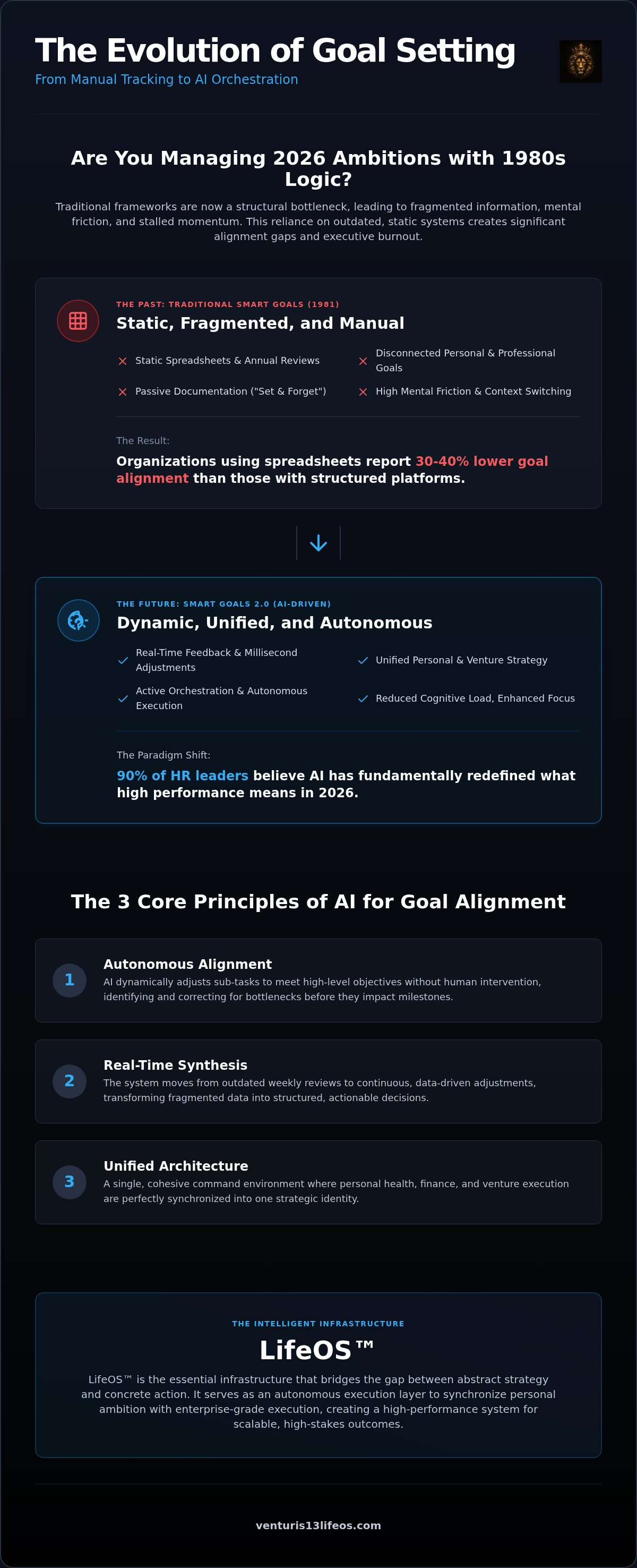
The 1981 traditional SMART goals framework was designed for a world of predictable cycles and linear growth. It's an artifact of the industrial age. In 2026, the velocity of capital, information, and competition has rendered static goal-setting obsolete. Smart Goals 2.0 represents a fundamental transition from passive documentation to active orchestration. This isn't a mere update. It's a total architectural redesign. We're moving away from the "set and forget" mentality toward a dynamic, unified infrastructure where strategy and execution exist in a perpetual, real-time feedback loop. For the modern founder, goal alignment is no longer a management task; it's a structural necessity.
The Failure of Traditional Goal Frameworks in 2026
Static spreadsheets can't keep pace with the volatility of modern venture workflows. They're brittle. They're silent. When a market shift occurs on Tuesday, a spreadsheet remains unchanged until the manual review on Friday. This delay creates alignment gaps where resources are squandered on low-impact tasks. Organizations using structured goal-setting platforms report 30 to 40 percent higher alignment than those relying on spreadsheets, according to 2026 industry data. For leaders, the psychological toll of fragmented data is immense. Managing disconnected personal priorities alongside professional milestones creates a state of constant mental friction. It leads to strategic drift. Wasted capital, fragmented focus, and executive burnout are the inevitable results of using outdated tools to solve modern complexities.
Defining Smart Goals 2.0: The AI Paradigm Shift
The shift to Smart Goals 2.0 is driven by AI for goal alignment. This paradigm shift introduces an autonomous execution layer that bridges the gap between high-level vision and daily action. Unlike traditional methods, AI for goal alignment allows for millisecond adjustments. If a sub-task falls behind, the system re-orchestrates the entire workflow to maintain the trajectory toward the primary objective. This is unified intelligence. It synthesizes data from every corner of your life and venture. It transforms fragmented data into structured decisions. The system operates through three core principles:
- Autonomous Alignment: AI adjusts sub-tasks dynamically to meet high-level objectives without human intervention.
- Real-Time Synthesis: The platform moves from weekly reviews to continuous, data-driven adjustments.
- Unified Architecture: A single environment where personal health, finance, and venture execution are perfectly synchronized.
A 2026 global survey found that 90 percent of HR leaders believe AI has fundamentally redefined what high performance means. To thrive, you must move beyond tracking. You must build a digital architecture that supports scalable outcomes. It's the transition from passive thought to active, structured output. This is the blueprint for the next generation of venture success.
The Mechanics of AI for Goal Alignment: Beyond Simple Tracking
Tracking is a historical audit; alignment is a future-facing orchestration. Most organizations fail because they mistake the map for the journey. They focus on visual progress bars and manual updates, creating a veneer of productivity that masks underlying structural decay. True AI for goal alignment requires an architectural shift away from manual oversight toward an autonomous execution layer. This layer acts as the vital bridge between abstract strategy and concrete action. It's a silent engine that operates with invisible efficiency, ensuring that every micro-task serves the macro-objective. By the time a human identifies a bottleneck, the opportunity for correction has often passed. AI eliminates this latency by identifying friction points in complex workflows before they impact milestones.
Autonomous Execution Layers and Strategic Governance
The transition from task management to strategic governance marks the end of the era of manual team coordination. In 2026, an autonomous execution layer is a self-regulating digital framework that translates high-level strategic intent into granular, machine-orchestrated workflows without human intervention. This system doesn't just record what happened. It governs what happens next. It orchestrates team coordination, resource allocation, and milestone tracking without the need for constant executive input. By offloading these operational burdens to AI, leaders move away from the frantic energy of typical productivity tools toward a state of calm, disciplined, and hyper-competent governance. It's the difference between managing a list and architecting a result.
Real-Time Data Synthesis for Strategic Decisions
Fragmented data is the primary driver of wasted capital and strategic drift. When personal performance metrics, financial data, and venture execution exist in separate silos, the founder operates in a fog of war. By leveraging AI for structured business outcomes, you replace intuitive guessing with data-backed venture execution. Predictive analytics now play a central role in forecasting, treating personal health and performance data as critical inputs for business strategy. According to Anthropic's 2026 State of AI Agents Report, 80 percent of organizations report that their AI agent investments are already delivering measurable economic returns. This success is rooted in the transition from passive thought to active, structured output.
The integration of personal and venture intelligence allows the system to transform fragmented ambitions into measurable progress. If the AI detects a dip in executive performance or a misalignment in financial priorities, it re-orchestrates the venture's tactical layer to maintain strategic integrity. This creates a unified command environment that supports scalable outcomes while reducing the cognitive load on the individual. For those seeking a sophisticated approach to growth, implementing a unified personal and venture intelligence system is the only logical evolution. It ensures that every action is a precise contribution to your long-term vision.
Bridging the Gap: Personal Performance and Venture Execution
The distinction between the individual and the enterprise is a relic of twentieth-century management theory. In the high-stakes environments of 2026, this separation is not just artificial; it's detrimental. A founder's personal clarity dictates venture success. Unified identity is the new standard. It is the fusion of personal priorities, health metrics, and financial status with the execution of the venture. When these elements are siloed, mental friction increases. When they are integrated, you achieve a state of hyper-competent emotional and strategic stability. This is the transition from passive thought to active, structured output.
Effective AI for goal alignment must account for the biological and financial realities of the leader. If your sleep quality drops or your personal liquidity shifts, the venture's tactical layers must adapt. This isn't about balance. It's about orchestration. It's about building a unified intelligence architecture that supports high-stakes decision-making through total data transparency. The system operates as a silent engine, managing the complexities of modern life while you focus entirely on results. It values discipline, scalability, and the seamless fusion of intelligence and action.
Personal Identity vs. Venture Objectives
Work-life separation is a myth in high-performance environments. The architecture of your life is the foundation of your business. AI creates a frictionless loop between personal well-being and venture speed. It monitors the inputs that drive output. By treating health and finance as critical strategic inputs, the system ensures personal priorities are never sacrificed for venture growth. Instead, they are synchronized to fuel it. This is the elimination of the transformation paradox, where old metrics are discarded in favor of holistic, real-time alignment. You gain order, clarity, and the elimination of mental friction.
Unified Intelligence for Multi-Venture Founders
Serial entrepreneurs face the challenge of fragmented focus across multiple boards. Managing portfolio companies through a single command environment is the only way to maintain strategic integrity. Using AI for managing multiple companies creates massive operational leverage. It's about maintaining cultural and strategic alignment across diverse teams without manual intervention. The AI acts as the silent engine of governance, ensuring that every venture reflects the founder's core vision. This unified intelligence allows for the seamless fusion of intelligence and action across a diverse portfolio, valuing discipline, scalability, and results above all else.
Architecting Your AI-Powered Command Environment
Legacy software is a collection of features; a command environment is a system of intelligence. Most CEOs are currently drowning in feature bloat, managing a dozen platforms that offer noise instead of clarity. This fragmented approach is the antithesis of scalable success. To thrive in 2026, you must transition from passive software to an active AI operating system. This is the shift toward institutional-grade infrastructure. It is the construction of a digital architecture that does not just store data but actively orchestrates outcomes. By implementing a sophisticated AI for goal alignment, you transform your digital workspace into a high-performance engine that operates with invisible, hyper-intelligent efficiency. This infrastructure provides the order, clarity, and discipline required to move from passive thought to active, structured output.
Eliminating Mental Friction through Cognitive Offloading
Decision fatigue is the silent killer of strategic momentum. Every low-level decision, such as scheduling, follow-ups, and data entry, consumes executive bandwidth that should be reserved for high-stakes governance. Cognitive offloading is the architectural solution to this friction. By delegating operational minutiae to an autonomous execution layer, you preserve your mental energy for visionary leadership. The reduction of cognitive load is the primary driver of strategic speed in high-stakes environments. AI identifies, categorizes, and executes routine workflows, ensuring that your cognitive resources are focused entirely on results. This is the elimination of mental friction through a robust and sophisticated ecosystem designed for scalability.
Scaling Collective Intelligence and Coordinated Action
Alignment is not a one-time event; it is a continuous state of synchronization. In traditional environments, team coordination relies on manual project management, which is a slow, error-prone process that creates information silos. A modern command environment uses AI to align every team workflow with the founder’s core vision. This ensures that collective intelligence is not just gathered, but actively deployed toward specific milestones. To verify your trajectory, you should utilize the AI for business outcome forecasting checklist to maintain rigorous progress tracking. This transition from manual oversight to AI-driven coordination allows your venture to scale without the typical friction of organizational growth. If you are ready to move beyond fragmented tools, you can establish your unified AI business infrastructure with LifeOS today.
LifeOS™: The Intelligent Infrastructure for Unified Goal Execution
LifeOS™ is the category-defining AI Business and Life Infrastructure. It marks the end of the era where leaders had to juggle fragmented tools to manage a unified life. This is the institutional-grade solution for those who demand precision. By centralizing personal priorities and venture execution, LifeOS™ eliminates the friction that typically derails high-growth founders. You move from a state of reactive management to one of proactive governance. Fragmented information is a liability. Structured decisions are essential. LifeOS™ provides the intelligence layer required to bridge this gap, ensuring that every action is a calculated step toward your primary objectives. The superior orchestration provided by LifeOS™ ensures that your AI for goal alignment is not just a feature; it's a foundational pillar of your venture's architecture.
From Strategy to Actionable Progress
Grand visions often dissolve in the heat of daily operations. LifeOS™ prevents this decay by transforming abstract strategy into coordinated, daily action. It's the only system designed for the 2026 digital economy, integrating your finances, identity, and ventures into a single source of truth. This integration provides a decisive advantage. You aren't just tracking goals. You're orchestrating a legacy. The system acts as a silent engine, managing the underlying mechanics of your life while you focus on high-stakes execution. This is the future of venture infrastructure: autonomous, intelligent, and entirely focused on results. It’s the transition from passive thought to active, structured output.
The Architecture of Unified Intelligence
Serial entrepreneurs understand that focus is their most valuable asset. LifeOS is the essential evolution for those managing multiple boards and complex portfolios. It reduces the gap between ambition and measurable business outcomes by providing a unified intelligence layer. This isn't a flexible canvas for manual entry. It's a high-performance machine for strategic output. In 2026, an AI operating system is no longer a luxury. It's a fundamental requirement for anyone serious about scalable success. By leveraging AI for goal alignment within a unified infrastructure, you secure a level of clarity that competitors cannot match. It's time to abandon the manual systems that break at scale and adopt the infrastructure of the future. For leaders ready to secure their competitive edge, the path forward is clear: integrate, automate, and dominate.
The Sovereign Command of Your Future
The era of manual tracking has reached its logical end. You've seen how static frameworks fail in high-growth environments; they're brittle, silent, and inefficient. By adopting AI for goal alignment, you shift from passive observation to active orchestration. You've learned that a unified identity, where personal health and finance fuel venture execution, is the only way to scale without friction. This marks the transition from fragmented noise to structured, institutional-grade decisions. It's the architectural shift your ambition requires.
LifeOS™ represents the visionary AI business infrastructure required for this evolution. It's not a tool; it's a silent engine designed for scalable venture execution and unified personal intelligence. By integrating your core priorities with your venture's tactical layers, you create a command environment that operates with invisible efficiency. You gain order, clarity, and the elimination of mental friction.
Secure your venture's future with LifeOS™ — the AI Operating System for High-Performance Leaders. The path to hyper-competence is paved with discipline, scalability, and the seamless fusion of intelligence and action. Build the infrastructure that your future demands.
Frequently Asked Questions
How does AI specifically improve goal alignment compared to manual methods?
AI eliminates the latency inherent in manual tracking by providing a real-time, autonomous feedback loop. While manual methods rely on periodic reviews and static documentation, AI for goal alignment orchestrates resources, identifies bottlenecks, and re-allocates tasks instantly. This ensures that the tactical layer is always synchronized with the strategic vision without human intervention. It transforms a passive map into an active, self-correcting engine.
What is the difference between SMART goals and AI-driven Smart Goals 2.0?
Traditional SMART goals are passive milestones; Smart Goals 2.0 are active, self-regulating infrastructures. The 1981 framework focuses on static criteria, whereas the 2026 model utilizes agentic intelligence to adjust sub-tasks dynamically. It transforms a simple checklist into a robust ecosystem that values discipline, scalability, and the seamless fusion of intelligence and action. It moves from documentation to orchestration.
Can AI help align personal life goals with professional business objectives?
AI unifies these domains by treating personal health, finances, and identity as critical inputs for venture execution. By merging these silos, the system creates a unified personal and venture intelligence that prevents strategic drift. It ensures that personal well-being fuels venture speed, eliminating the artificial barrier between the individual and the enterprise. The result is a single, cohesive strategic identity focused on results.
Is an AI operating system necessary for early-stage venture founders?
An AI operating system is essential for founders who intend to build institutional-grade startups from day one. Implementing LifeOS early prevents the accumulation of technical and operational debt caused by fragmented information. It provides the architectural foundation necessary for scalable venture coordination. This allows founders to focus on high-stakes decision-making rather than the frantic energy of manual oversight.
How does AI for goal alignment reduce mental friction for executives?
AI reduces cognitive load by automating low-level operational decisions and administrative minutiae. By offloading these tasks to a silent engine of governance, executives mitigate decision fatigue and preserve bandwidth for visionary leadership. This process of cognitive offloading ensures that mental energy is spent on results rather than the mechanics of coordination. It replaces mental clutter with structured, architectural clarity.
What are the key features of an AI-powered command environment for ventures?
A sophisticated command environment features autonomous execution layers, predictive analytics, and unified data synthesis. It moves beyond simple task management to provide strategic governance, real-time bottleneck identification, and portfolio-wide orchestration. These features create a state of calm, disciplined, and hyper-competent control over complex venture workflows. It is the transition from passive software to an active, intelligent operating system.
How does LifeOS handle data privacy while unifying personal and professional info?
LifeOS employs institutional-grade security protocols to ensure that unified personal and professional data remains sovereign and secure. The system is designed to provide order and clarity without compromising individual privacy through advanced encryption and localized processing. Governance remains central to the architecture. This ensures that data integration serves the user’s strategic objectives exclusively while maintaining the highest standards of digital integrity.
Can AI predict if a venture will meet its quarterly goals based on current alignment?
AI utilizes predictive analytics to forecast business outcomes based on the current state of alignment across all organizational layers. By analyzing real-time data feeds, the system identifies deviations from the strategic path and suggests corrective measures before milestones are missed. This transitions the management process from intuitive guessing to data-backed venture execution. It provides a level of certainty that traditional spreadsheets cannot replicate.