The Venture Execution Layer: Why Startups are Replacing SaaS with AI Infrastructure in 2026
The era of the fragmented software stack is dead. While founders once believed that adding more SaaS tools would lead to higher productivity, the reality in 2026 is a landscape of digital clutter, disjointed data, and profound decision fatigue. This friction has birthed the venture execution layer for startups, a unified architectural shift that moves beyond passive record-keeping into active, autonomous orchestration. It's no longer enough to manage tasks; you must govern outcomes through a singular, intelligent engine.
You likely feel the weight of the strategy-execution gap every time you pivot between dozens of disconnected applications. You're tired of vision failing to translate into team action. This article explores how a unified venture execution layer for startups closes that gap by replacing traditional SaaS with high-performance AI infrastructure like LifeOS. We will examine the transition from manual context switching to a unified command environment. You'll discover how autonomous workflows and integrated intelligence are becoming the new standard for scaling ventures with absolute discipline, clarity, and speed.
Key Takeaways
- Understand how the venture execution layer for startups acts as the autonomous bridge between high-level strategy and daily tactical output, eliminating the fragmentation of legacy SaaS stacks.
- Identify the "Integration Tax" caused by managing dozens of disconnected applications and learn why unified AI infrastructure is the essential path to maintaining startup speed.
- Discover the power of merging personal and professional data streams into a single command environment to eliminate mental friction and decision fatigue.
- Learn to synchronize human teams with autonomous agentic workflows to ensure that every strategic vision translates into measurable progress.
- Master the transition from a fragmented software stack to a sovereign, unified operating system using the LifeOS architecture.
Table of Contents
- What is a Venture Execution Layer? Defining the 2026 Standard
- The Evolution of Startup Infrastructure: From SaaS to AI Operating Systems
- The Three Pillars of a High-Performance Execution Stack
- Bridging the Founder-Venture Gap: The Role of Unified Identity
- Implementing LifeOS™: Your Sovereign Venture Execution Layer
What is a Venture Execution Layer? Defining the 2026 Standard
The traditional startup stack is a graveyard of disconnected subscriptions. For years, founders have relied on a fragmented array of SaaS tools to manage growth, yet these tools only record history; they do not create it. The venture execution layer for startups represents a fundamental departure from this passive model. It's the autonomous infrastructure that sits between high-level strategy and daily operations. Unlike traditional SaaS, which thrives on data silos and manual input, the execution layer functions as a unified command environment. It's the bridge that finally connects what a founder intends to do with what the venture actually achieves.
This evolution builds upon the Lean Startup methodology by automating the build-measure-learn loop that was previously managed through manual labor. We're moving from tools that track work to systems that execute work.
The Anatomy of an Execution Layer
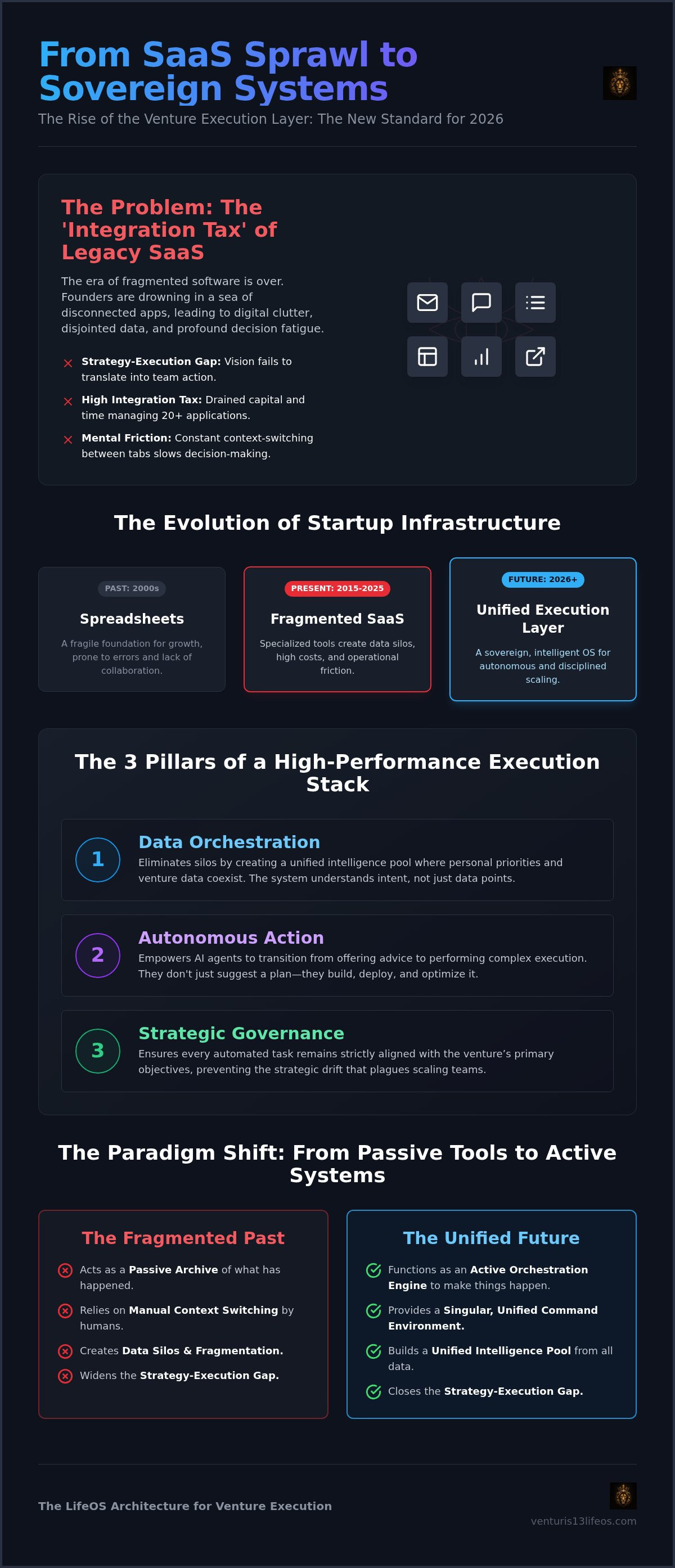
A true execution layer is defined by three structural pillars that transform how a business operates. First, Data Orchestration eliminates silos by creating a unified intelligence pool where personal priorities and venture data coexist. This ensures that the system understands the founder's intent as deeply as the company's balance sheet. Second, Autonomous Action empowers AI agents to transition from offering mere advice to performing complex execution. These agents don't just suggest a marketing plan; they build, deploy, and optimize it. Finally, Strategic Governance ensures every automated task remains strictly aligned with the venture’s primary objectives, preventing the drift that often plagues rapidly scaling teams.
Why 2026 is the Year of the Execution Layer
The "SaaS sprawl" model has reached a breaking point under the weight of AI complexity. As capabilities exploded, the mental friction of managing dozens of different interfaces became a liability rather than an asset for fast-moving teams. High-performing founders are now adopting digital architecture for high achievers to regain their competitive edge and eliminate decision fatigue. This shift marks the end of the era where humans act as the "glue" between different software platforms. The execution layer is the sovereign engine of modern venture growth.
The Evolution of Startup Infrastructure: From SaaS to AI Operating Systems
The trajectory of startup infrastructure is a study in escalating complexity. In the early 2000s, spreadsheets provided a fragile foundation. By 2015, the cloud SaaS explosion offered specialized tools for every niche, yet it introduced a hidden "Integration Tax." Managing twenty or more disconnected applications doesn't just drain capital; it creates a fragmented intelligence that slows decision-making to a crawl. In 2026, the venture execution layer for startups has emerged as the institutional-grade response to this chaos. It replaces the "Integration Tax" with a singular, sovereign architecture designed for rapid, intelligent scaling.
A Harvard Business School study highlights that AI-native organizations operate with significantly higher capital efficiency by automating core operational loops. This efficiency isn't achieved through better spreadsheets, but through a fundamental shift toward unified intelligence. It's the difference between having a library of data and having a system that reads, understands, and acts upon that data in real time.
The Failure of Fragmented Project Management
Legacy tools like Asana and Jira are increasingly viewed as passive archives. They record what has happened, but they lack the agency to make things happen. For the multi-venture founder, these platforms become a source of mental friction. The cost of constant context switching between tabs and task lists is a primary driver of the Strategy-Execution Gap. This is why forward-thinking leaders are abandoning traditional lists for executive productivity infrastructure. This new standard moves beyond tracking to active orchestration, ensuring that vision is never lost in the noise of administrative maintenance.
The Sovereign Operating System Model
The transition to a Sovereign OS model represents the pinnacle of modern digital architecture. Unlike generic SaaS, a sovereign system provides the founder with absolute control, uncompromising privacy, and unified data flow. It enables true cognitive offloading, where the leadership team no longer needs to remember the "where" or "how" of a project. Workflows shift from being user-driven to AI-orchestrated. In this environment, the venture execution layer for startups acts as a silent engine, managing complex dependencies with invisible efficiency. To achieve this level of clarity, founders must move toward intelligent infrastructure that unifies their entire professional ecosystem.
The Three Pillars of a High-Performance Execution Stack
The architectural integrity of a venture execution layer for startups rests upon three non-negotiable pillars. These aren't separate features connected by fragile, third-party APIs; they're integrated components of a singular, high-performance engine. To truly own the execution layer, a founder must move beyond the "app for that" mentality. The goal is a seamless fusion of intelligence, action, and feedback. When these pillars are integrated rather than merely connected, the resulting system operates with a level of discipline that manual stacks cannot replicate. This is the difference between a collection of tools and a sovereign infrastructure for growth.
Unified Intelligence and Decision Support
Fragmented data is the primary cause of strategic drift. By synthesizing every data point into a coherent narrative, the system transforms fragmented ambitions into structured decisions. This pillar merges personal priorities with professional data streams to create a comprehensive intelligence pool. It reduces the mental friction inherent in high-stakes choices by providing clarity where there was once noise. Unified data acts as the connective tissue of a venture, ensuring that the leadership's intent is reflected in every automated workflow and tactical adjustment. It's a top-down approach to intelligence that eliminates the need for manual data synthesis.
Orchestrating Coordinated Team Action
We're moving beyond simple collaboration toward a model of autonomous orchestration. In a traditional environment, humans act as the manual interface between different software platforms. In a venture execution layer for startups, the system itself synchronizes human teams with AI agentic workflows. This ensures that every action remains aligned with the primary venture goals, regardless of team size or geographic distribution. Institutional-grade governance is essential here; it provides the guardrails for autonomous agents to execute complex tasks without human oversight. The result is a silent engine of productivity that maintains momentum even when the founder is offline. This shift from "user-driven" to "system-orchestrated" work is what allows early-stage ventures to scale with the precision of a much larger organization.
Finally, measurable progress provides the real-time feedback loops required for strategic agility. Instead of waiting for monthly reports, founders receive immediate data on how daily tactical output impacts high-stakes outcomes. This creates a closed-loop system where strategy and action are no longer separate events, but a continuous, self-correcting cycle of execution.
Bridging the Founder-Venture Gap: The Role of Unified Identity
Founders often maintain the strategic fallacy that their personal lives and business operations exist in separate spheres. In the high-stakes environment of 2026, this siloing is a primary source of friction. A venture execution layer for startups rejects this division, recognizing that the founder’s cognitive state is the most critical piece of infrastructure in the entire organization. Modern scaling requires the total integration of personal priorities with venture execution. When these elements are unified, the venture operates with the speed, clarity, and precision of the founder’s own intent. It transforms the leader from a potential bottleneck into a sovereign engine of growth.
The concept of the "Founder Operating System" has moved from theory to literal requirement. LifeOS unifies personal identity, financial data, and venture workflows into a single command environment. This architecture ensures that the founder’s vision is not just a document on a server, but the active logic driving every automated task. By bridging this gap, startups eliminate the mental context switching that traditionally degrades performance. They move away from the frantic energy of managing tools toward a calm, disciplined state of hyper-competence.
Cognitive Offloading for Serial Entrepreneurs
Serial entrepreneurs face the compounding challenge of managing multiple high-stakes companies simultaneously. The mental overhead required to maintain focus across different industries can be paralyzing. A robust execution layer acts as a "Second Brain" that does more than archive data; it performs work. It manages the mundane, handles the repetitive, and orchestrates the complex. For a deeper analysis of this systemic approach, founders should study the Architecture of Unified Intelligence. This infrastructure allows a leader to step back from the role of a task manager to become a strategic architect, focusing exclusively on high-leverage decisions.
The Identity-Outcome Loop
Sustainable growth is only possible when personal identity aligns perfectly with venture milestones. By 2026, elite founders are prioritizing mental clarity as a primary ROI metric. They understand that decision fatigue is a structural failure, not a personal one. AI infrastructure protects the founder’s "Zone of Genius" by automating everything outside of it. This creates a self-reinforcing loop of order and output:
- Elimination of mental context switching between personal and professional domains.
- Autonomous governance of personal finances alongside venture capital management.
- Structured ambition translated into disciplined, measurable tactical progress.
To move beyond the limitations of fragmented SaaS and secure your own sovereign command environment, explore the LifeOS AI Business and Life Infrastructure today.
Implementing LifeOS™: Your Sovereign Venture Execution Layer
Transitioning to a venture execution layer for startups is a strategic migration from chaos to order. It's a move away from the frantic maintenance of tools toward the disciplined governance of a sovereign system. This process isn't merely technical; it's architectural. It requires a fundamental shift in how you view the relationship between your data, your team, and your growth. To achieve institutional-grade performance, founders must follow a methodical implementation path that replaces fragmentation with unified intelligence.
- Step 1: The Infrastructure Audit. Map your current fragmented stack to identify where data is trapped, where context is lost, and where manual effort is wasted.
- Step 2: Unified Integration. Transition your core data streams into the LifeOS™ command environment to establish a single source of truth.
- Step 3: Blueprint Definition. Codify your venture’s strategic logic into "Execution Blueprints" that dictate how the system should respond to specific triggers.
- Step 4: Agentic Deployment. Activate autonomous AI agents to manage complex, multi-stage workflows that previously required human glue.
- Step 5: Disciplined Scaling. Leverage the clarity of your new infrastructure to scale operations without the proportional increase in mental friction.
LifeOS™ for Individuals and Teams
The system is designed to scale with your ambition. While the standard LifeOS™ unifies the founder's individual intelligence, the LifeOS™ Enterprise Plan extends this orchestration to the entire venture team. It replaces the frantic noise of traditional messaging apps with structured, agent-led coordination. There are no pings, only progress. This is the logical conclusion of the evolution from SaaS. We've moved beyond talking about work in one app and doing it in another. In the Enterprise environment, communication and execution are a single, seamless event.
Future-Proofing Your Venture Infrastructure
Building your startup on a unified execution layer creates a structural defensibility that a collection of disparate apps cannot match. A fragmented stack is a liability; a sovereign OS is an asset. This model ensures that your data history remains structured, clean, and ready for future AI training. As your venture matures, this unified history becomes the "Institutional Memory" that drives even more precise autonomous actions. You're not just buying software; you're building a moat. It's time to Transform your venture execution with LifeOS™ and secure the sovereign engine of your future growth.
The Sovereign Future of Venture Growth
The shift from fragmented SaaS to a unified venture execution layer for startups is more than a technical upgrade. It's a fundamental realignment of how vision becomes reality. By integrating personal identity with professional workflows, you eliminate the mental friction that traditionally stalls high-stakes progress. You've explored how autonomous orchestration and unified intelligence provide the institutional-grade foundation necessary for scaling in 2026. The era of manual context switching and digital clutter is officially over. In its place stands a disciplined, silent engine of execution that operates with invisible efficiency and total clarity.
Success in the modern landscape requires a sovereign command environment that bridges the gap between individual performance and collective output. Now is the time to move beyond the limitations of legacy tools and fragmented data. Architect your venture execution layer with LifeOS™ to secure a category-defining AI Business and Life Infrastructure. Order, clarity, and the elimination of mental friction are now within your reach. Step into the next generation of leadership with a system designed for your highest ambitions and most complex workflows.
Frequently Asked Questions
What is the difference between a venture execution layer and a project management tool?
A venture execution layer for startups is an active engine of action, while project management tools are merely passive systems of record. Legacy tools track what happened; the execution layer ensures what should happen actually occurs through autonomous orchestration. It moves beyond simple task lists to provide a unified command environment where strategy, intelligence, and tactical output are fused into a single, disciplined system.
How does an AI operating system help in managing multiple startups?
An AI operating system acts as a centralized intelligence hub that maintains deep context across disparate business entities. It eliminates the mental friction of context switching by managing the unique data, priorities, and workflows of each venture within a single sovereign engine. This allows serial entrepreneurs to govern multiple companies with the same clarity, discipline, and focus they would apply to a single project.
Is a venture execution layer suitable for early-stage startups or only for scale-ups?
This infrastructure is essential for ventures at every stage, from the earliest seed rounds to institutional scaling. Early-stage founders use it to maintain capital efficiency and extreme lean operations. Scale-ups deploy it to ensure that as the team grows, the original strategic intent remains perfectly aligned across global human teams and autonomous agentic workflows. It's the foundation for disciplined growth.
How does LifeOS™ handle data privacy and security for sensitive venture information?
LifeOS™ utilizes a sovereign architectural model that prioritizes absolute control, uncompromising privacy, and institutional-grade security. Your venture data isn't used to train public models; it remains within your private intelligence pool. This architecture ensures that sensitive financial data, strategic blueprints, and personal priorities are protected by robust governance protocols and encrypted orchestration layers, providing a secure environment for high-stakes execution.
Can I integrate my existing tools into a venture execution layer?
You can integrate existing data streams, but the ultimate objective is to eliminate the fragmented SaaS sprawl. The execution layer acts as the primary intelligence engine, pulling data from legacy sources to create a unified command environment. Over time, most founders find that the autonomous capabilities of the venture execution layer for startups render traditional, disconnected, and manual subscriptions obsolete.
What is cognitive offloading, and why is it important for founders?
Cognitive offloading is the process of transferring the mental burden of task management and decision synthesis to an intelligent system. For founders, it's the difference between being a bottleneck and being a strategic architect. By automating the mundane and orchestrating the complex, the system protects the founder's "Zone of Genius" and eliminates the decision fatigue that traditionally degrades leadership performance and clarity.
How does the LifeOS Enterprise Plan differ from the individual version?
The individual version unifies personal priorities and venture intelligence for a single leader, while the LifeOS Enterprise Plan is built for team coordination. The Enterprise edition introduces agentic orchestration for entire departments, ensuring that human teams and AI agents work in perfect synchronicity. It provides the institutional-grade governance, oversight, and synchronization required to maintain strategic alignment across a growing, high-performance organization.
What are the first steps to implementing an execution layer in 2026?
Implementation begins with a comprehensive audit of your current fragmented stack to identify specific friction points and data silos. Once identified, you transition your core intelligence into a unified command environment and define your "Execution Blueprints." These blueprints act as the logic for your autonomous agents, allowing you to deploy a system that manages complex workflows and scales with absolute precision.