AI for Operational Clarity: ClickUp for Venture Management
The traditional project management suite is no longer a competitive advantage. It is a liability. For the modern founder, the friction of context switching, the isolation of information silos, and the widening gap between strategic ambition and daily execution have become unsustainable. While many sophisticated platforms exist for venture management, even advanced solutions can fail to bridge the divide between visionary intent and team output. You require a system that functions as a silent engine: efficient, autonomous, and decisive – the very essence of LifeOS™ by Venturis 13.
You recognize that scaling multiple ventures demands more than just organized lists; it requires total operational governance. This article demonstrates why high-stakes venture management in 2026 requires moving beyond simple project tools toward a unified AI operating system. We will explore the architecture of a unified command environment, the mechanics of autonomous team coordination, and the specific strategies needed to achieve absolute clarity on your most critical strategic decisions. The transition from passive thought to active, structured output begins with a fundamental shift in your business infrastructure.
Key Takeaways
- Master the transition from fragmented data streams to absolute operational clarity by synthesizing information into actionable, high-stakes strategic intelligence.
- Evaluate the limitations of using ClickUp for venture management as a standalone tool and learn why a robust AI operating system is essential for orchestrating complex ventures.
- Reduce cognitive load and mental friction by integrating personal identity with venture execution within a single, unified command environment.
- Establish the necessary data structures to move beyond manual task management toward a state of autonomous team coordination and intelligent governance.
- Shift from traditional project management to institutional-grade infrastructure that bridges the gap between grand strategic ambition and daily operational excellence.
Table of Contents
- Defining Operational Clarity in the Age of Unified Intelligence
- The Architectural Shift: Why ClickUp for Venture Management is Only the Beginning
- Orchestrating High-Stakes Decisions with Unified Intelligence
- Implementing a Command Environment for Autonomous Venture Scaling
- LifeOS™: The Institutional Grade Infrastructure for Strategic Leaders
Defining Operational Clarity in the Age of Unified Intelligence
Operational clarity is not a luxury. It is the architectural foundation upon which successful ventures are built. In 2026, the executive landscape has shifted. Leaders are no longer struggling with a lack of information; they are drowning in it. They face a paradox of being constantly notified but rarely informed. True clarity emerges only when fragmented data streams converge into structured, strategic decisions. It is the difference between seeing the noise and understanding the signal. Without this lens, the modern founder remains a prisoner of the immediate, unable to focus on the essential.
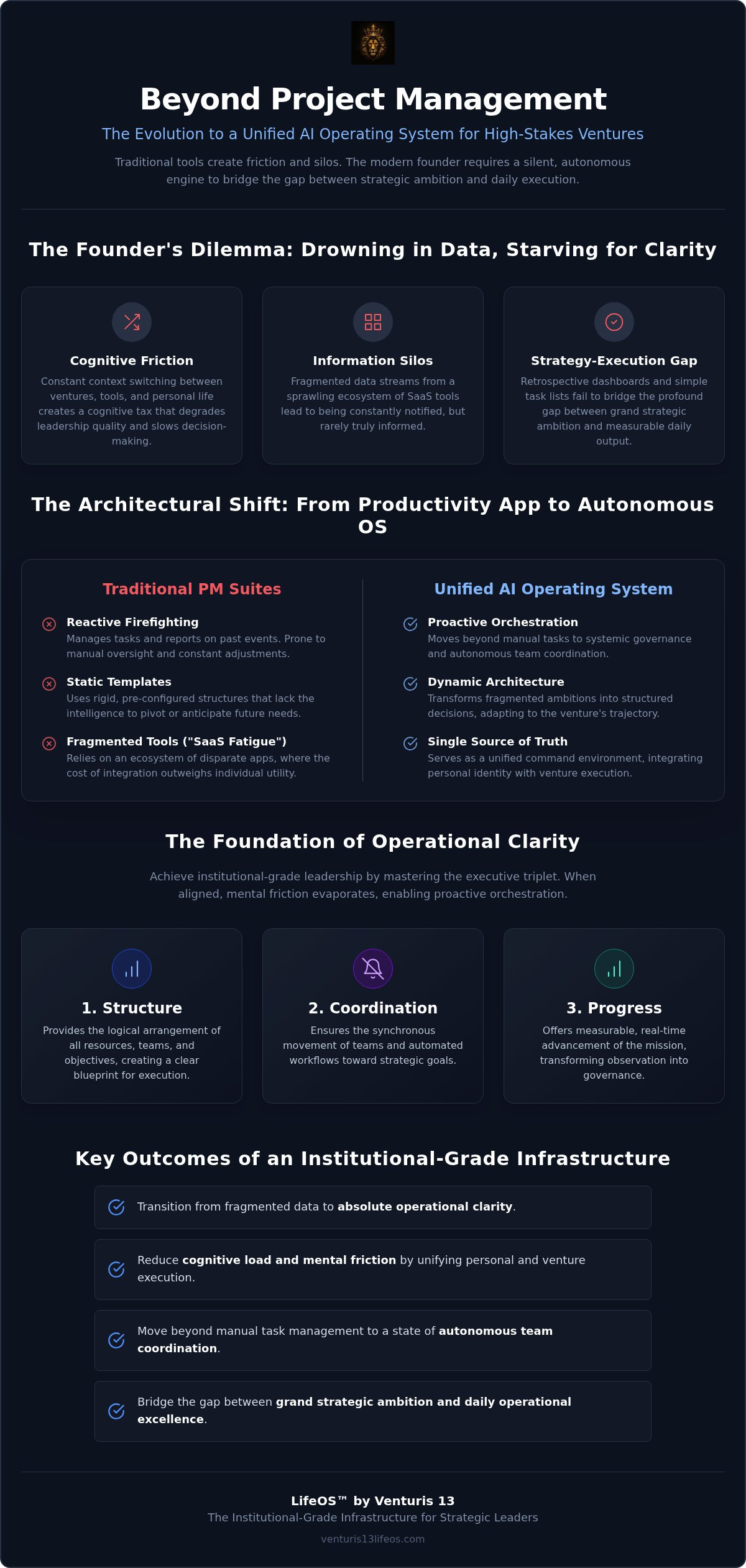
To lead effectively, you must embrace the executive triplet: Structure, Coordination, and Progress. Structure provides the logical arrangement of resources. Coordination ensures the synchronous movement of teams. Progress offers the measurable advancement of the mission. When these three elements align, mental friction evaporates. You move from a state of reactive firefighting to one of proactive orchestration. This is the hallmark of institutional-grade leadership.
The Paradox of Choice in Venture Management
Modern CEOs manage a sprawling ecosystem of SaaS tools. Each platform promises efficiency, yet the collective result is mental friction and decision fatigue. Context switching between personal life and multiple venture teams creates a cognitive tax that degrades leadership quality. While many attempt to use ClickUp for venture management, the tool often becomes another silo rather than a unified command center. The complexity of Venture capital (VC) requires a level of orchestration that traditional project management simply cannot provide. You don't need more features; you need a unified intelligence that understands your strategic intent.
Why Dashboards are Insufficient for the Modern Founder
Dashboards report the past. They summarize what has already occurred, offering a retrospective view that fails to architect the future. Visualization is not execution. Knowing your burn rate or task completion percentage is not the same as moving the needle on a high-stakes strategic objective. There is a profound gap between tracking tasks and achieving scalable outcomes. Many founders rely on ClickUp for venture management to see what happened yesterday, but they lack the infrastructure to dictate what happens tomorrow. Operational clarity is the bridge between strategic ambition and measurable results. It transforms passive observation into active, decisive governance. It ensures that every action taken by every team member is a direct contribution to the founder's ultimate vision.
The Architectural Shift: Why ClickUp for Venture Management is Only the Beginning
Tasks are the granular units of labor. Ventures are the complex architectures of ambition. Many founders initially adopt ClickUp for venture management, drawn by its approachable interface and pre-configured templates. Yet, templates are fundamentally static artifacts. They capture a moment in time rather than the dynamic trajectory of a scaling enterprise. A template lacks the capacity to pivot, the intelligence to anticipate, and the authority to govern. While a tool might help you organize a funding round, only a dedicated infrastructure can orchestrate the long-term health of a portfolio.
The transition from a productivity app to an Autonomous Execution Layer represents a fundamental shift in leadership philosophy. It is the movement from manual oversight to systemic governance. In this new paradigm, AI for operational clarity transforms fragmented ambitions into structured decisions. It ensures that the founder's strategic intent is not lost in a sea of subtasks but is instead the driving force behind every automated workflow. This architectural evolution is necessary to maintain operational efficiency as the complexity of your ventures begins to outpace your cognitive bandwidth.
From SaaS to OS: The Evolution of Venture Infrastructure
The era of maintaining an isolated app for every business function is ending. Founders are experiencing "SaaS fatigue," where the cost of integrating disparate tools outweighs their individual utility. We are witnessing a shift toward unified AI operating systems that serve as a single source of truth. A tool merely collects data; an operating system executes strategy. For leaders seeking a more robust framework, exploring Linear alternatives for venture management reveals a growing demand for systems that prioritize speed, logic, and integration over simple feature lists. To truly scale, you must move beyond the "app" mindset and adopt a comprehensive venture intelligence platform.
The Role of Predictive Modeling in 2026
By August 2026, the baseline for venture management has shifted from historical reporting to predictive orchestration. It is no longer sufficient to see what your team did last week. You must anticipate market shifts before they manifest in your project timeline. Advanced AI infrastructures now utilize predictive modeling to identify bottlenecks, resource gaps, and strategic opportunities in real time. This allows you to shift from reactive management to proactive venture orchestration. You are no longer checking boxes; you are steering a command environment that operates with invisible, hyper-competent efficiency. This system doesn't just track progress; it ensures it, acting as a silent engine that powers your strategic vision without requiring your constant intervention.
Orchestrating High-Stakes Decisions with Unified Intelligence
High-stakes decisions require a synthesis of intelligence that transcends mere task completion. For the visionary leader, the separation between personal life and professional execution is an artificial construct that generates unnecessary friction. Unified Intelligence is the remedy. It is the seamless fusion of a founder’s identity, priorities, and venture workflows into a singular, cohesive environment. When you use ClickUp for venture management, you often find yourself managing the tool rather than the mission. You need a system that functions as an extension of your own cognitive process; a system that prioritizes, filters, and executes with institutional precision.
The architecture of progress depends on connecting daily action to long-term strategic ambitions. Without a single system of record, your vision becomes diluted across fragmented platforms. Absolute clarity is only possible when you can see the direct line between a morning priority and a quarterly venture milestone. This level of integration ensures that your focus remains sharp, your energy remains high, and your results remain consistent. It is the transition from passive thought to active, structured output.
Eliminating Mental Friction through Cognitive Offloading
Offloading the burden of decision-making to an intelligent environment is the ultimate executive leverage. Cognitive load is the silent killer of strategic ambition. By utilizing a digital architecture designed for high-performance, you can transition from a state of constant mental fatigue to one of calm, disciplined focus. This is the core philosophy behind The Architecture of Unified Intelligence. Institutions are already transforming venture capital with AI to improve due diligence and resource allocation. As a founder, you must apply these same principles to your internal operations. LifeOS™ serves as this silent engine, managing the complexities of your daily life so you can remain focused on the high-level governance of your empire.
Strategic Alignment Across Multiple Portfolio Ventures
Managing a single venture is difficult. Orchestrating a portfolio of multiple companies is an architectural challenge of a different magnitude. Strategic alignment becomes exponentially harder as you add teams, cap tables, and market variables. A unified interface provides the absolute clarity required to maintain control without succumbing to the chaos of context switching. If your current implementation of ClickUp for venture management leaves you feeling disconnected from your core vision, it is time to move toward a more robust solution. Implementing AI for multi-venture portfolio management ensures that every team, regardless of their specific mission, remains in lockstep with your strategic intent. This connectivity is the bridge between daily action and long-term strategic ambition, ensuring that every move you make is a calculated step toward measurable progress.
Implementing a Command Environment for Autonomous Venture Scaling
Transitioning from manual oversight to autonomous coordination is the defining move of the 2026 founder. It is a methodical shift. First, you must dismantle the reliance on manual status updates. Second, you must establish a system that anticipates needs before they are voiced. Third, you must automate the alignment of team actions with high-level strategic objectives. Using ClickUp for venture management often traps leaders in a cycle of constant manual verification. Scaling requires a system that operates with invisible efficiency, allowing you to focus on the next horizon.
AI cannot optimize chaos. Before introducing autonomous execution layers, your venture data must be architected with precision. This means standardizing how financial data, team communications, and strategic goals are recorded. Without this structural discipline, AI is merely a faster way to generate noise. Establish your governance, define your parameters, and then let the intelligence take over. This is how you achieve speed without sacrificing control.
Building the Venture Execution Layer
To build an effective execution layer, you must define measurable outcomes that an AI system can recognize and optimize. This involves integrating every facet of the venture into a single, unified environment. Team communication, financial health, and strategic milestones must exist in a shared space. This integration removes the friction of data silos and ensures that every piece of information is actionable. The execution layer serves as the structural conduit that translates abstract strategy into autonomous, measurable results.
From Task Management to Strategic Orchestration
Completing tasks is a legacy metric. In 2026, venture founders must measure success through strategic orchestration rather than granular output. You are no longer a manager of people; you are the strategic architect of an autonomous system. This transition involves orchestrating complex workflows that involve multiple stakeholders, automated triggers, and real-time market adjustments. You move from the frantic energy of the daily grind toward a calm, disciplined state of high-level control. Achieving this requires moving beyond traditional tools to a unified AI business infrastructure that supports your transition from operator to visionary.
LifeOS™: The Institutional Grade Infrastructure for Strategic Leaders
LifeOS™ by Venturis 13 represents the category-defining evolution of business and life infrastructure. It is not a mere application; it is a robust AI Operating System designed for the uncompromising founder. While many organizations rely on ClickUp for venture management to track basic milestones, LifeOS™ unifies personal priorities, finances, and identity with complex venture workflows. It functions as a silent engine, operating with invisible efficiency to eliminate the mental friction inherent in managing multiple high-stakes portfolios. This is the institutional-grade solution for those who demand absolute clarity, speed, and precision.
The platform's architecture transforms fragmented data into structured decisions. By establishing a unified command environment, founders can finally bridge the gap between their strategic ambition and daily operational execution. For leaders managing diverse teams and intricate cap tables, the LifeOS Enterprise Plan provides the specialized coordination required to maintain high-level governance. It's the essential infrastructure for scaling ventures in an era where speed is the primary currency. You no longer need to manage your tools; you need a system that manages your ventures.
Transforming Ambition into Structured Outcomes
A founder's performance is inextricably linked to their environment. LifeOS™ unifies personal performance with professional execution, ensuring that every action is a direct contribution to a measurable result. For the serial entrepreneur, a single command environment is the only way to maintain strategic focus across multiple ventures. This integration is the core of Executive Productivity Infrastructure, providing the new standard for intelligent execution. It's about moving from passive thought to active, structured output without the cognitive tax of context switching. You deserve a system that reflects the scale of your ambition.
The Future of Venture Command Environments
2026 is the year of the AI Operating System. The competitive landscape no longer rewards those who simply work harder; it rewards those who build better systems. Institutional-grade management is the new baseline for startups seeking to outpace the market. Using ClickUp for venture management may provide a basic framework, but it cannot offer the autonomous coordination and predictive intelligence required for true scaling. The era of manual task tracking has ended. You are invited to join the evolution of venture management. Transition from being an operator to a strategic architect. Embrace the infrastructure that dictates progress, ensures clarity, and secures your legacy. The future is structured; it's time your ventures reflected that reality.
Architect Your Strategic Legacy
Leadership in 2026 demands more than just organization. It requires the seamless fusion of intelligence, action, and results. While ClickUp for venture management serves as a competent entry point, it lacks the institutional-grade depth needed for high-stakes portfolio orchestration. You must move beyond the constraints of traditional SaaS tools toward a category-defining AI infrastructure that unifies your personal identity with professional execution. This transition ensures that every strategic decision is rooted in absolute clarity, every team action is aligned with your core vision, and every venture operates with invisible, hyper-competent efficiency.
Strategic leaders deserve an environment that functions as a silent engine for their ambition. It's time to move from fragmented thought to structured, measurable progress. Secure your strategic command environment with LifeOS™ and experience the definitive standard for intelligent management. Designed for the elite serial entrepreneur, this platform provides the clarity and speed your empire requires. Step into a state of calm, hyper-intelligent control and lead your ventures with the certainty they deserve.
Frequently Asked Questions
What is an AI command environment for executives?
An AI command environment is a unified digital infrastructure that synthesizes personal priorities and venture workflows into a single, cohesive interface. It serves as a central hub for governance, orchestration, and high-level decision-making. Unlike fragmented applications, it provides a top-down view of all strategic initiatives. It functions as a silent engine, empowering high-performance leaders to maintain absolute control over their professional and personal ecosystems.
How does AI improve data-driven decision making in 2026?
By August 2026, AI utilizes predictive modeling to identify market shifts and resource bottlenecks before they impact your operations. Advanced systems analyze vast datasets to offer actionable intelligence rather than retrospective reports. This allows you to shift from reactive firefighting to proactive strategic orchestration. It ensures every decision is backed by real-time structural logic, transforming passive observation into active, decisive governance across your entire portfolio.
Can AI help in managing multiple business ventures simultaneously?
AI provides the architectural foundation to manage diverse teams, complex cap tables, and varied market conditions from one unified interface. It eliminates the cognitive tax of context switching by maintaining a single source of truth for all entities. While many use ClickUp for venture management as a starting point, true multi-venture scaling requires a system that automates alignment. This connectivity secures your strategic intent across your entire empire.
What is the difference between a project management tool and an AI operating system?
A project management tool tracks tasks and deadlines; an AI operating system orchestrates ventures and executes strategy. Tools are often static repositories for fragmented data that require constant manual updates. In contrast, an operating system is a dynamic infrastructure that governs workflows, automates decisions, and integrates personal performance. It transforms you from a manual operator into a strategic architect of your own autonomous ecosystem.
How does unified intelligence reduce mental friction for CEOs?
Unified intelligence reduces cognitive load by offloading complex decision-making and administrative coordination to an intelligent environment. It bridges the gap between personal identity and professional execution, creating a state of calm, disciplined focus. By consolidating fragmented SaaS ecosystems into a singular command center, it eliminates the mental friction caused by information silos. Leaders can finally focus on grand, high-level visions instead of being buried in notifications.
Is an AI operating system secure for high-stakes venture data?
Institutional-grade AI operating systems utilize advanced encryption and private infrastructure to protect sensitive venture capital data. Security isn't an afterthought; it's the architectural baseline for high-stakes governance. These systems offer robust data sovereignty, ensuring that proprietary strategic intelligence remains under your absolute control. You gain the power of automation without compromising the integrity of your information or the privacy of your strategic roadmap.
How does LifeOS™ transform fragmented data into structured outcomes?
LifeOS™ acts as a sophisticated execution layer that unifies disparate data streams into a cohesive strategic framework. It organizes information into the executive triplet of structure, coordination, and progress. By aligning daily actions with long-term ambitions, it ensures that data isn't just stored but utilized to drive measurable results. It's the definitive bridge between visionary thought and structured, autonomous output, providing the clarity required for elite performance.
What are the benefits of an autonomous venture execution layer?
An autonomous execution layer provides speed, scalability, and high-level control without requiring constant manual intervention. It allows ventures to pivot and adapt in real-time based on automated triggers and strategic parameters. Founders who move beyond basic ClickUp for venture management to an autonomous layer experience unprecedented operational clarity. This system ensures that the mission advances with invisible efficiency, freeing the leader to innovate and scale at a rapid pace.