The Future of Executive Control: The Unified Decision Making Platform
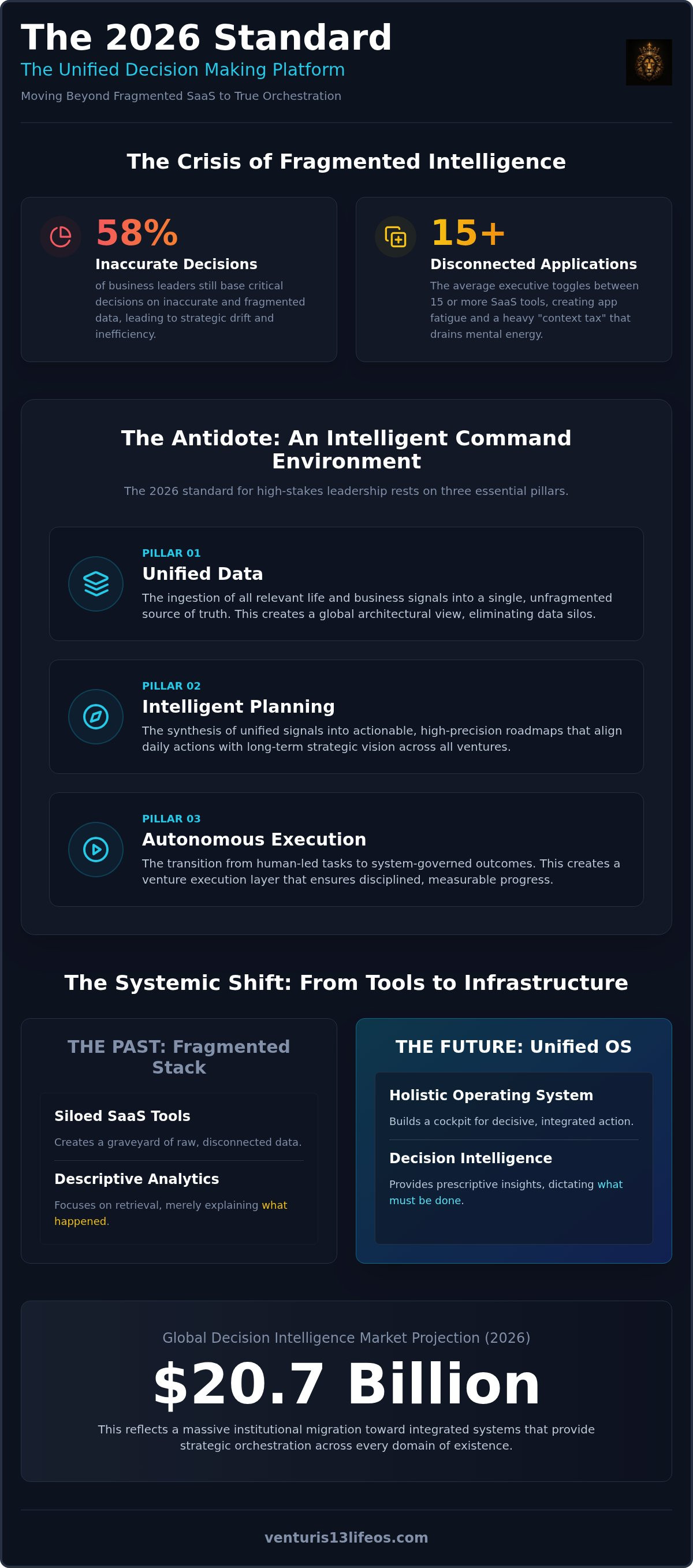
Recent data reveals that 58% of business leaders still base critical decisions on inaccurate, fragmented data. It's a staggering inefficiency that stems from a fundamental disconnect between personal intent and professional execution. You likely feel the weight of this friction every day as you toggle between ten different SaaS tools, chasing clarity through a haze of app fatigue. The solution isn't another dashboard. It's a unified decision making platform that acts as an architectural foundation for your entire life. This single command environment bridges the gap between raw ambition and measurable results. It offers the discipline, clarity, and control required to lead in an increasingly complex global economy.
You know that true strategic speed is impossible when your personal priorities and venture workflows exist in separate silos. We agree that the mental cost of switching contexts is the greatest tax on your productivity. This article demonstrates how to eliminate that friction by implementing an institutional-grade execution layer that aligns your daily actions with long-term goals. You'll learn how to transform chaotic information into structured progress, achieve total governance over multiple ventures, and finally master the transition from passive thought to active, scalable outcomes. We are moving beyond simple productivity toward true orchestration.
Key Takeaways
- Identify and eliminate the hidden mental friction of "fragmented intelligence" caused by disconnected personal and professional data silos.
- Understand the 2026 standard for a unified decision making platform, centering on the three pillars of unified data, intelligent planning, and autonomous execution.
- Transition from a collection of fragmented SaaS tools to a holistic Operating System (OS) architecture that enables deep integration and high-level governance.
- Follow a structured blueprint to audit data sources and establish a Unified Identity, ensuring personal performance directly drives venture outcomes.
- Discover how LifeOS™ functions as the ultimate execution layer, bridging the gap between grand strategic vision and disciplined, measurable action.
Table of Contents
- The Crisis of Fragmented Intelligence: Why Siloed Systems Fail Founders
- What is a Unified Decision Making Platform? The 2026 Standard
- SaaS vs. Operating System: Choosing Your Venture Infrastructure
- Architecting Clarity: Implementing a Unified Command Environment
- LifeOS™: The Intelligent Infrastructure for Venture Leaders
The Crisis of Fragmented Intelligence: Why Siloed Systems Fail Founders
Fragmented intelligence is the silent killer of high-stakes ambition. It represents the widening chasm between a founder's personal identity and their venture's operational data. When your financial health, strategic vision, and daily priorities exist in separate digital silos, your intelligence becomes local rather than global. You lose the architectural view of your life. This disconnect forces the executive mind to serve as the primary integration layer, a role that human biology was never designed to sustain. In 2026, simply having "integrated data" is no longer the benchmark for success. True leadership requires a unified decision making platform that provides strategic orchestration across every domain of existence.
The traditional "SaaS Stack" has failed the modern founder. While the average executive manages 15 or more disconnected applications, this fragmented infrastructure creates a graveyard of raw data rather than a cockpit for decisive action. Each tool demands its own context, its own login, and its own mental model. This creates operational chaos that masks underlying strategic drift. Historically, a Decision Support System (DSS) focused on isolated business metrics, but today's landscape demands a fusion of personal performance and venture execution. Without this fusion, you aren't leading a system; you are merely reacting to its noise.
Cognitive Offloading and the Founder's Mental Load
High-stakes decisions require a pristine cognitive workspace. Every time you switch between a personal wealth tracker and a business project management tool, you pay a heavy "context tax" that drains executive energy. Effective mental friction reduction for CEOs is not about doing more. It is about thinking less about the mundane to focus on the monumental. By offloading the burden of data synthesis to a unified decision making platform, you transition from managing tasks to governing systems. You reclaim the mental bandwidth necessary to architect the future rather than just surviving the present.
The Strategy-Execution Gap in Modern Ventures
Vision often fails because it lacks a structured path to reality. In most ventures, the strategy exists in a slide deck while the execution happens in a chaotic mess of emails and chat threads. This gap is where speed dies. Unified intelligence ensures that every team member's action is an echo of the founder's core intent. It creates a single source of truth that maintains alignment across multiple, complex ventures simultaneously. A Venture Execution Layer is the essential bridge between raw ambition and scalable outcomes. It transforms passive thought into active, disciplined, and hyper-competent output that moves the needle on your most critical objectives.
What is a Unified Decision Making Platform? The 2026 Standard
Architecture is the antidote to chaos. A unified decision making platform is not a simple dashboard or a glorified project management tool. It is an intelligent command environment designed to unify personal priorities with venture execution. While traditional software focuses on information retrieval, the 2026 standard demands decision intelligence. This shift represents a move from descriptive analytics, which merely explain what happened, toward prescriptive and predictive insights that dictate what must be done. The global decision intelligence market is projected to reach approximately $20.7 billion in 2026, reflecting a massive institutional migration toward these integrated systems.
This platform architecture rests on three essential pillars that transform raw ambition into structured progress:
- Unified Data: The ingestion of all relevant life and business signals into a single source of truth.
- Intelligent Planning: The synthesis of these signals into actionable, high-precision roadmaps.
- Autonomous Execution: The transition from human-led tasks to system-governed outcomes.
Unlike siloed SaaS tools that create data graveyards, a unified platform acts as a cohesive operating system. It ensures that every decision, from personal capital allocation to venture-level team coordination, is governed by a singular, strategic intent. It functions as a silent engine that operates with invisible efficiency, providing the clarity required to lead in a complex economy.
The Architecture of Unified Intelligence
High achievers require a sophisticated digital architecture for high achievers that treats personal identity as the core of the business engine. Integrating your personal finances, health data, and long-term priorities into the business workflow is no longer optional. It is the only way to maintain a single source of truth for both life and venture. When your personal performance is aligned with venture execution, you eliminate the mental friction that typically plagues the executive mind. This integration allows you to design, execute, and improve your life with institutional-grade control.
AI-Powered Decision Support Systems
Artificial intelligence serves as the orchestration layer that transforms fragmented data into structured business outcomes. In the current landscape, the rise of agentic AI allows these systems to perceive, reason, and act with minimal human supervision. This is the transition from suggesting to doing. Predictive analytics now forecast venture progress with precision, allowing you to stay ahead of market shifts. To achieve this level of control, you must move beyond passive tools and adopt a truly unified personal and venture intelligence infrastructure that drives results autonomously.
SaaS vs. Operating System: Choosing Your Venture Infrastructure
Founders often mistake a collection of software for a strategy. Traditional SaaS models focus on isolated functions, such as CRM, accounting, or project management, creating deep data silos that hinder rapid decision-making. These silos force you to manually bridge the gap between different data sets, a process that is slow, prone to error, and cognitively draining. In contrast, an Operating System (OS) provides a unified foundation where every component is designed to work in concert. This is the unified decision making platform in its most potent form. It replaces surface-level API connections with deep, structural integration, ensuring that your venture infrastructure is a silent engine of efficiency rather than a source of friction.
Governance is the primary differentiator. While SaaS tools give you a view of individual tasks, an OS provides a top-down architectural perspective of all your ambitions. For serial entrepreneurs managing multiple companies, this level of control is not a luxury. It's a requirement for scalability. An OS allows you to orchestrate resources, capital, and talent across various ventures without losing sight of the big picture. It transforms your role from a frantic manager of tools into an authoritative architect of outcomes. You stop fighting the software and start governing the system.
Beyond Task Management: The OS Evolution
Task-based systems are reactive. They focus on the "what" and the "when" without addressing the "why" or the "how" in a strategic context. The evolution toward outcome-based operating systems marks a significant shift in leadership technology. Implementing a robust executive productivity infrastructure is the new standard for 2026. This infrastructure serves as a Venture Execution Layer, acting as the bridge between your grandest visions and the daily actions of your teams. It ensures that every move is deliberate, every resource is optimized, and every outcome is measurable. You aren't just checking boxes; you're building a legacy through disciplined execution.
Institutional-Grade Control for Individuals
LifeOS™ brings the sophisticated infrastructure once reserved for enterprise-level corporations directly to the individual founder. It facilitates a critical transition from the chaotic energy of "hustle" to the calm discipline of "governance." By centralizing your personal identity and venture data within a unified decision making platform, you reduce operational complexity significantly. This reduction is the ultimate executive lever. It allows you to focus entirely on high-impact results while the system handles the orchestration of details. You gain the freedom to lead with visionary confidence, knowing that your life and business are supported by an institutional-grade foundation that values scalability and precision above all else.
Architecting Clarity: Implementing a Unified Command Environment
Establishing a unified decision making platform is a disciplined exercise in systems engineering. It isn't about adding another layer of software. It's about re-architecting your operational reality from the top down. Transitioning from fragmented chaos to institutional-grade control requires a methodical approach that prioritizes clarity, integration, and autonomy. By following a structured blueprint, you transform your digital environment into a silent engine that drives results with invisible efficiency.
The implementation process follows five critical stages of development:
- Step 1: Audit Fragmented Data. Identify every silo currently draining your energy. This includes not just business CRM and project tools, but also personal wealth trackers, health data, and priority lists.
- Step 2: Establish Unified Identity. Define the core venture goals that directly reflect your personal strategic intent. Your business should be an extension of your identity, not a separate burden.
- Step 3: Map Complex Workflows. Translate high-level vision into a structured execution layer. This ensures that tactical team coordination is always an echo of your primary objectives.
- Step 4: Automate Strategic Alignment. Utilize AI-driven goal tracking to maintain focus. This eliminates the need for manual check-ins and keeps the entire venture on a precise trajectory.
- Step 5: Monitor and Refine. Use unified intelligence to create a continuous feedback loop. This allows you to refine decisions in real-time based on comprehensive, cross-domain data.
Transforming Ambition into Structured Action
Ambition without structure is merely noise. To move from passive thought to active output, you must employ high-precision forecasting. Integrating AI for business outcome forecasting allows you to predict milestones with architectural accuracy. This is where you set "Smart Goals 2.0," ensuring that personal performance and venture execution are mutually reinforcing. Structured decision tools reduce executive fatigue by removing the burden of constant mental synthesis from the founder's mind.
Managing Multi-Venture Workflows
Scaling across multiple business entities requires a single, sophisticated command center. You cannot maintain clarity and speed if you're forced to switch contexts between different corporate infrastructures. Unified data provides the foundation for high-stakes strategic decisions, allowing you to govern multiple ventures from one interface. This centralized orchestration is the only way to achieve true scalability without sacrificing precision. To build this foundation, you need an infrastructure that treats your life and business as a single, integrated system. Discover how to unify your world with the LifeOS™ AI Operating System and reclaim your strategic focus.
LifeOS™: The Intelligent Infrastructure for Venture Leaders
LifeOS™ by Venturis 13 represents the terminal point of executive evolution. It is the category-defining AI Business and Life Infrastructure that unifies personal finances, priorities, and identity with venture teams. This is the unified decision making platform that high-level leaders have historically lacked. It eliminates the mental friction of context switching by serving as the silent engine of your entire operation. It values discipline, scalability, and the seamless fusion of intelligence and action. By centralizing your life and business into a single command environment, you achieve a level of clarity that traditional SaaS stacks cannot provide.
For the serial entrepreneur, the LifeOS Enterprise Plan offers the ultimate execution layer. It facilitates venture-level team coordination through sophisticated AI business infrastructure. This isn't about surface-level integration. It's about deep, structural orchestration that ensures every team member's output is an echo of the founder's primary intent. You gain total operational clarity across multiple business entities, transforming raw ambition into a series of structured, measurable successes. This system moves beyond passive data collection to active, intelligent planning that drives your ventures forward autonomously.
LifeOS™ for the Strategic Architect
The platform functions as a high-performance partner, not a passive repository. It speaks to the strategic architect who demands a blueprint for total life and venture governance. The command environment features Red Dot-level design, offering an intuitive interface that replaces the frantic energy of typical apps with a calm, disciplined state. This fusion of intelligence and action ensures that scalable outcomes are not just possible but inevitable. It bridges the gap between grand strategy and tactical execution, allowing you to govern multiple ventures with institutional-grade control. You stop managing tools and start architecting a legacy.
Getting Started with LifeOS™
The path from fragmented information to structured progress begins with a single, decisive step. By adopting the 2026 standard for executive productivity, you move beyond the exhausted "hustle" and into the realm of professional governance. LifeOS™ provides the Intelligent Planning and Decision-Making tools required to stay ahead of regulatory shifts and market volatility. It is the logical conclusion for any founder seeking to eliminate operational complexity and reclaim their visionary focus. You don't need more tools. You need a better operating system that unifies your world.
Take the first step toward achieving total command over your life and ventures. Experience the power of unified decision making platform technology today. Discover the LifeOS™ AI Operating System and join the new generation of hyper-competent, visionary leaders.
The Era of Integrated Governance
The transition from fragmented intelligence to structured orchestration is no longer a choice for the modern founder; it's a survival requirement. By adopting a unified decision making platform, you eliminate the mental friction that drains executive energy and delays strategic action. You move beyond the chaos of disconnected apps toward a single source of truth that aligns your personal performance with venture execution. This is the blueprint for achieving institutional-grade control, total operational clarity, and scalable outcomes. The future belongs to the strategic architect who values discipline, clarity, and precision. You have the vision to lead; now you need the infrastructure to execute.
LifeOS™ by Venturis 13 provides the category-defining AI Life and Venture Infrastructure necessary for this evolution. It is the silent engine that transforms raw ambition into measurable progress through unified intelligence and autonomous orchestration. Secure Your Venture Infrastructure with LifeOS™. Your journey toward total operational clarity and hyper-competent leadership starts now.
Frequently Asked Questions
What is a unified decision making platform?
A unified decision making platform is an intelligent command environment that integrates personal data, strategic priorities, and venture execution into a single source of truth. Unlike siloed tools, it transforms raw information into structured decisions. It acts as the architectural foundation for high-performance leadership. It ensures that every action aligns perfectly with the founder's core identity and long-term vision.
How does a unified platform differ from traditional project management software?
Traditional project management tools are reactive, focusing on task completion and surface-level timelines. A unified platform is proactive and outcome-based. It provides a top-down view of all ambitions rather than just checking boxes. While project software often creates data silos, this platform functions as a cohesive operating system. It bridges the gap between grand strategy and tactical execution with precision.
Can a unified platform manage both personal priorities and business ventures?
Yes, the primary purpose of this infrastructure is the fusion of personal performance and venture execution. It treats your life and business as a single, integrated system. By unifying personal finances, priorities, and identity with venture workflows, it eliminates the artificial divide between work and life. This integration provides the clarity required to lead with visionary confidence across every domain.
What are the benefits of an AI-powered operating system for founders?
An AI-powered operating system provides intelligent planning, predictive forecasting, and autonomous execution. It moves beyond simple information retrieval to offer genuine decision intelligence. Founders benefit from the "silent engine" effect, where the system orchestrates complex details invisibly. This allows the executive mind to focus entirely on high-impact strategic results rather than getting lost in mundane coordination.
How does a unified platform reduce mental friction for CEOs?
It reduces mental friction by eliminating the context tax associated with switching between disconnected SaaS tools. A unified decision making platform provides a pristine cognitive workspace. It offloads the burden of data synthesis and mental integration to the system itself. CEOs can operate in a calm, disciplined, and hyper-competent state, free from the exhaustion of chronic app fatigue.
Is a unified decision making platform suitable for managing multiple companies?
It is the essential standard for serial entrepreneurs who must govern multiple business entities simultaneously. The platform provides a centralized command center for coordinating teams and resources across different ventures. It ensures that strategic intent remains consistent regardless of operational complexity. This level of scalability is a core feature of institutional-grade infrastructure designed for complex growth.
What is the 'Venture Execution Layer' in LifeOS™?
The Venture Execution Layer is the structural bridge between raw ambition and scalable outcomes. It maps high-level vision into structured, measurable progress for entire teams. In LifeOS™, this layer ensures that tactical coordination is always an echo of the founder's primary strategic goals. It effectively closes the strategy-to-action gap that often plagues complex, high-stakes ventures and ambitious founders.
How does LifeOS™ handle data privacy and security for high-stakes ventures?
LifeOS™ is built with institutional-grade security protocols designed to protect sensitive personal and corporate intelligence. It adheres to the 2026 standards for data governance and AI transparency, including compliance with the data governance requirements of the EU AI Act. The platform ensures clear data lineage and fitness-for-purpose. High-stakes ventures receive the robust protection required for total operational security and peace of mind.