Strategic Workflow Automation: The Founder’s Guide to Autonomous Execution in 2026
The era of the fragmented founder is over. While 40% of enterprise applications now feature task-specific AI agents, most leaders remain trapped in the manual orchestration of their own ambitions. You likely feel the weight of operational opacity, the friction of disconnected SaaS tools, and the persistent drift between your personal priorities and venture execution. This is not a productivity crisis; it's an architectural failure. By implementing strategic workflow automation, you can finally transition from a passive task tracker to a visionary architect of an autonomous execution layer.
You recognize that true scaling requires more than just faster work. It demands a unified command environment where strategy, intelligence, and action exist in a single, seamless flow. This guide provides the blueprint to transform fragmented ambitions into a disciplined, high-performance system that scales your ventures with absolute clarity. We will explore the shift from traditional task management to intelligent orchestration, the integration of personal and venture intelligence, and the mechanics of building a silent engine that drives measurable progress toward your highest stakes goals.
Key Takeaways
- Distinguish between tactical task automation and the superior model of an autonomous execution layer designed for complex multi-venture orchestration.
- Eliminate the cognitive load of fragmented SaaS environments by implementing strategic workflow automation that unifies data, logic, and action.
- Construct a digital architecture that integrates personal identity with venture intelligence to ensure every automated trigger aligns with your primary objectives.
- Execute a cognitive load audit to pinpoint operational friction and map high-level strategic goals to measurable, automated outcomes.
- Transition to a unified AI Business and Life Infrastructure to achieve a state of hyper-competent, disciplined scaling across all ventures.
Table of Contents
- Beyond Task Management: Redefining Strategic Workflow Automation
- The Architecture of a Unified Intelligence Environment
- Linear Workflows vs. Strategic Orchestration: A Framework for Scaling
- Implementing Strategic Automation: A Roadmap for Founders
- LifeOS™: The Intelligent Command Environment for Ventures
Beyond Task Management: Redefining Strategic Workflow Automation
Efficiency is a deceptive metric when it lacks architectural direction. For the modern founder, the era of saving isolated minutes is over; the era of governing autonomous outcomes has begun. Tactical automation focuses on the trivial, such as moving data between spreadsheets or triggering email notifications. Strategic workflow orchestration, however, focuses on the essential. It unifies fragmented ambitions into a singular, high-performance engine. This evolution marks the definitive end of the fragmented SaaS era, where founders were forced to act as the manual glue between disconnected tools.
To better understand the fundamental shift from manual coordination to systemic execution, watch this overview of modern automation:
While foundational Business Process Automation provides the logic for individual tasks, strategic workflow automation provides the architecture for the entire venture. It is the bridge between high-level ambition and measurable outcome. By creating an Autonomous Execution Layer, you reduce executive mental friction and ensure that every automated action serves a primary strategic goal.
The Collapse of Traditional Productivity Tools
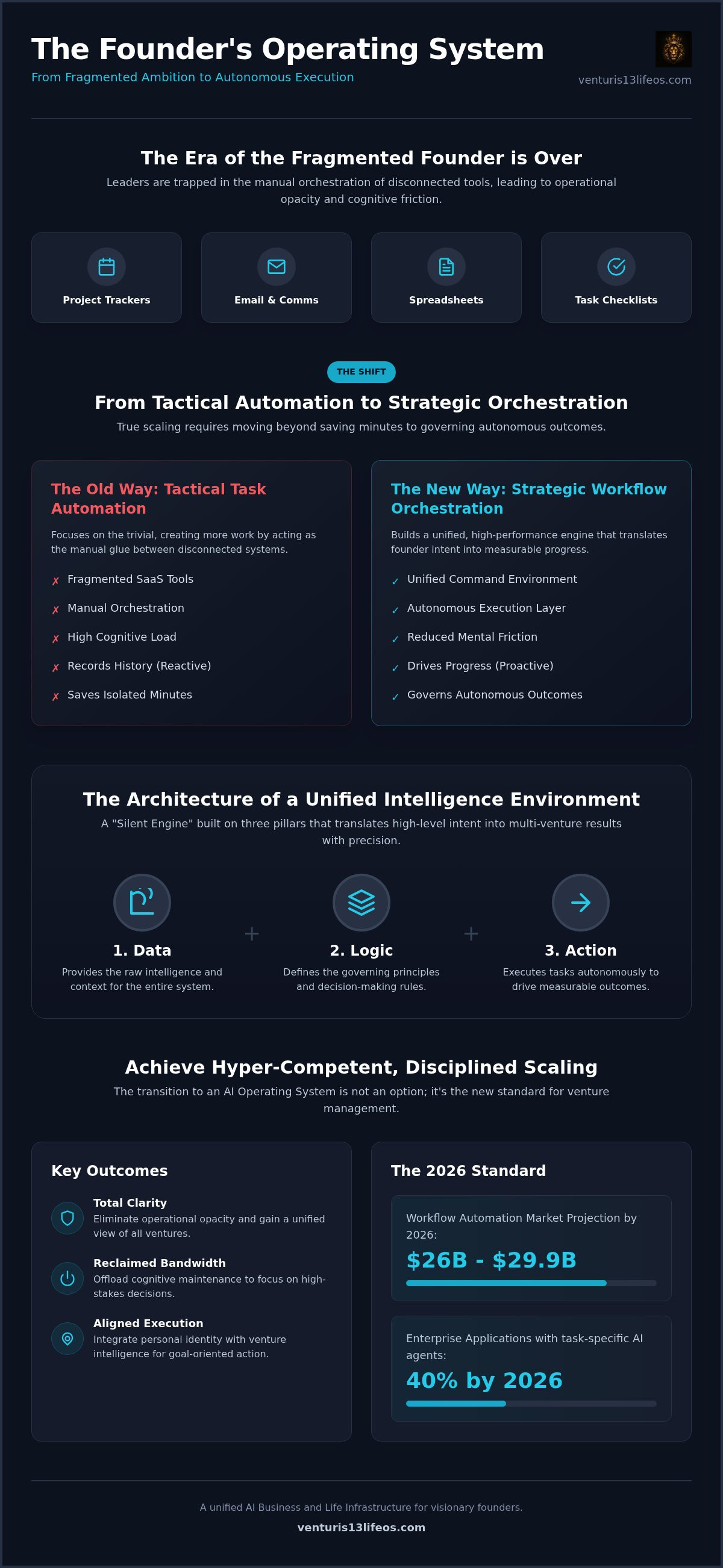
Checklists, Kanban boards, and static project trackers are failing the modern entrepreneur. These tools were built for a slower world. They record history; they don't drive progress. For the serial entrepreneur, the cost of switching between disconnected venture environments is no longer sustainable. This operational opacity creates a cognitive tax that prevents rapid scaling. By 2026, the global workflow automation market is projected to reach between $26.01 billion and $29.94 billion, driven by leaders who refuse to tolerate the mental friction of context switching. True execution requires a transition from passive tracking to an active, intelligent environment.
The 2026 Standard: Automation as Strategy
The new standard for venture management is the AI Operating System. Systems are moving beyond simple "if-then" triggers toward goal-oriented logic. With 40% of enterprise applications expected to feature task-specific AI agents by the end of 2026, the infrastructure of execution is becoming autonomous. This is the promise of LifeOS™, a unified environment that manages personal identity and venture intelligence simultaneously. Strategic workflow automation is the architectural discipline of mapping high-level founder intent to a self-correcting, unified execution layer that operates independently of manual oversight.
The Architecture of a Unified Intelligence Environment
The "Silent Engine" represents the ultimate evolution of executive agency. It's an invisible infrastructure that operates with absolute precision, translating high-level intent into multi-venture results. Building this environment requires more than simple software; it requires a structural commitment to the three pillars of digital architecture: Data, Logic, and Action. Data provides the raw intelligence. Logic provides the governing principles. Action provides the autonomous execution. When these pillars are aligned, the system functions as a high-performance machine that eliminates mental friction and operational opacity.
Strategic workflow automation is the methodology used to fuse these pillars into a single command center. This goes beyond mere digitization. Just as Local Government Modernization has shifted toward systemic workflow essentialism to manage complex public needs, the private founder must modernize to manage the complexities of multiple ventures. By offloading cognitive maintenance to this autonomous layer, you reclaim the mental bandwidth necessary for high-stakes decision-making. It's about moving from active management to passive governance.
Merging Personal Performance with Venture Execution
A founder's identity is the primary driver of their enterprise. Disconnecting personal health, finances, and priorities from venture execution is a fundamental error that leads to burnout and misalignment. When your personal data flows into the same command center as your business intelligence, you create a powerful feedback loop. High-performance execution requires The Architecture of Unified Intelligence to ensure that personal capacity matches professional demand. This unified approach ensures your personal priorities dictate the pace of your ventures, rather than the other way around.
The Venture Execution Layer: Closing the Strategy Gap
The strategy gap is where ambitions go to die. It's the void between a grand vision and the daily mechanics required to realize it. Strategic workflow automation closes this gap through autonomous governance. Instead of manually reviewing every metric, your system identifies anomalies, triggers responses, and reports progress based on pre-defined strategic objectives. This is the core of LifeOS™, transforming raw data into structured, decisive action without human intervention. Every automated trigger serves the primary goal. Every workflow reinforces the architectural intent. The result is a venture portfolio that scales with invisible efficiency, allowing the founder to remain in a state of calm, hyper-intelligent focus.
Linear Workflows vs. Strategic Orchestration: A Framework for Scaling
Linearity is the enemy of the serial entrepreneur. While traditional project management tools excel at tracking static lists, they fail to govern the dynamic interplay of multiple high-stakes ventures. Scaling requires a shift toward strategic workflow automation, an architectural discipline that moves beyond the simple "if-then" logic of task management. You aren't merely checking boxes; you're orchestrating an empire through institutional-grade systems that prioritize movement, alignment, and results. This evolution ensures that your ventures scale with absolute clarity rather than fragmented effort.
The Limits of Task-Based SaaS
Task-based SaaS platforms often create a paradox: the more tools you add, the less clarity you possess. Managing a project is a tactical chore, but architecting a venture is a strategic imperative. Many founders struggle with legacy tools that prioritize individual activity over systemic results. To break this ceiling, leaders require Linear Alternatives for Venture Management that focus on flow, logic, and outcome. Relying on fragmented environments leads to context switching, operational drag, and cognitive fatigue. High-performance execution demands a unified view, which is why Operational Clarity for Venture Management is only possible when you move beyond the task-centric trap that consumes so much executive energy.
Orchestration: The Multi-Venture Advantage
Orchestration provides the multi-venture advantage. It offers a "Single Pane of Glass" for executive control, allowing you to see across all entities simultaneously. By leveraging AI for Multi-Venture Portfolio Management, you transition from a manual mediator to a systemic architect. Your role is no longer to direct tasks, but to refine the autonomous logic that drives them. This unified approach ensures that team actions remain aligned with your primary strategic objectives, regardless of industry or geography. Strategic workflow automation creates a silent engine of efficiency, processing data and triggering actions with invisible precision. It is the difference between managing a collection of projects and governing a unified, scalable venture ecosystem. You don't need more tools; you need a better architecture that executes your strategy autonomously.
Implementing Strategic Automation: A Roadmap for Founders
The transition from manual mediation to systemic governance is not a software upgrade. It is an architectural shift. While 88% of organizations now use AI automation in at least one business function, few founders have achieved the level of unified orchestration required for multi-venture management. Implementing strategic workflow automation requires a disciplined mapping of founder intent to digital infrastructure. It demands a move away from constant oversight toward exception-based management, where you only intervene when the system identifies a strategic anomaly.
Phase 1: The Strategic Audit
You cannot automate what you haven't defined. The first stage of implementation is a ruthless audit of your cognitive load. You must isolate high-value strategic decisions from the low-value operational noise that currently consumes your bandwidth. Identify the bottleneck: where does your vision get strangled by manual tasks? Is it in team coordination, financial tracking, or lead orchestration? A comprehensive Decision Audit serves as the foundational diagnostic for identifying where strategic intent is currently strangled by manual friction. By pinpointing these friction points, you can prioritize the workflows that offer the highest return on your mental energy.
Phase 2: Architectural Implementation
Once the audit is complete, you must construct the infrastructure that connects your identity, goals, and team workflows. This is the creation of your Command Environment. It involves setting up autonomous guardrails that ensure the system operates within your core values and strategic parameters. Instead of managing people, you manage the logic that guides them. This architectural approach ensures that your strategic workflow automation remains aligned with your long-term objectives. You move from a state of frantic reaction to one of disciplined, hyper-competent execution. The system becomes a silent engine, processing data and triggering actions with invisible precision across your entire portfolio.
To begin building your own autonomous execution layer and reclaim your executive agency, explore the Venture and Life Infrastructure designed for the next generation of strategic leaders. This transition allows you to focus entirely on results, leaving the mechanics of execution to a system that never sleeps and never drifts from your original intent. Audit your friction. Map your triggers. Build your empire.
LifeOS™: The Intelligent Command Environment for Ventures
The fragmentation of the modern founder's life is a structural liability. To scale ventures with absolute clarity, you must move beyond the limitations of disconnected SaaS tools and passive task trackers. LifeOS™ represents the definitive evolution of technology into a unified AI Business and Life Infrastructure. It is the architectural realization of strategic workflow automation, serving as the autonomous execution layer that bridges the gap between high-level ambition and tangible, measurable progress. By centralizing your digital existence into a single command environment, you eliminate the cognitive load of manual orchestration.
A Single System for Everything That Matters
True executive agency requires the seamless fusion of personal identity and professional output. LifeOS™ unifies your personal priorities, finances, and health with venture-level coordination. This creates a powerful Unified Intelligence layer that informs every decision you make. You no longer need to switch contexts to understand your capacity or your capital. This is the Executive Productivity Infrastructure required for high-stakes execution. It ensures that your personal growth and your venture's success are not just aligned, but integrated into a single, high-performance flow.
Scalable Outcomes through LifeOS™ Enterprise
Scaling collective intelligence is the primary challenge of the multi-venture entrepreneur. The LifeOS™ Enterprise Plan extends the power of autonomous execution to your entire team, providing a unified command environment for professional execution. It shifts the paradigm from management to orchestration. Instead of tracking individual tasks, you govern the systems that drive them. This institutional-grade infrastructure allows for the coordination of complex workflows with speed, control, and clarity. It removes the operational opacity that often prevents rapid growth in multi-venture portfolios.
The future of venture execution belongs to those who prioritize architecture over activity. By implementing strategic workflow automation through a unified operating system, you reclaim your mental bandwidth and focus entirely on high-level strategy. The drift between thought and action ends here. You have the blueprint; now you need the engine. Join the evolution of venture management at LifeOS™ by Venturis 13 and transform your fragmented ventures into a unified, autonomous empire.
The Final Architecture of Executive Agency
The transition from manual mediation to autonomous governance is the definitive shift of the next decade. You've explored how the collapse of traditional productivity tools necessitates a move toward a unified intelligence environment. By implementing strategic workflow automation, you transform fragmented ambitions into a disciplined, silent engine of execution. This is not about saving minutes. It's about reclaiming your cognitive bandwidth for the high-stakes decisions that define your empire.
You now possess the roadmap to transition from a passive task tracker to a visionary architect. The category-defining AI Business and Life Infrastructure of LifeOS™ provides the next-generation command environment needed to unify personal performance with venture results. This is your opportunity to eliminate mental friction, achieve hyper-competent scaling, and establish total governance across every venture you lead.
Architect your autonomous future with LifeOS™
The path to invisible efficiency and relentless progress is open. Step into the future of orchestration and build with the precision your ventures deserve.
Frequently Asked Questions
What is the difference between workflow automation and strategic workflow automation?
Workflow automation is a tactical tool; strategic workflow automation is an architectural discipline. While traditional automation saves time on isolated tasks, strategic orchestration unifies disparate workflows into a single, autonomous execution layer. It moves beyond simple triggers to ensure every automated action aligns with your high-level venture objectives. This transition eliminates the operational opacity that prevents rapid scaling in complex, multi-venture environments.
Can strategic workflow automation work for managing multiple companies at once?
Strategic orchestration is the primary solution for multi-venture founders. It provides a unified command environment that allows for the simultaneous governance of different companies without the mental friction of context switching. By centralizing venture intelligence, you maintain absolute clarity and control across your entire portfolio. This unified approach ensures that team actions remain aligned with the founder's core intent across every entity simultaneously.
Do I need to be a technical founder to implement a strategic automation layer?
You don't need a technical background to implement a sophisticated automation layer. The 2026 standard emphasizes low-code and no-code platforms that empower strategic leaders to build and modify systems without programming experience. Your role is that of the architect, defining the logic, governance, and desired outcomes. The technology serves as a silent engine that executes your strategic vision with invisible efficiency and precision.
How does an AI Operating System differ from legacy productivity suites?
Legacy productivity suites and traditional document-based tools are passive repositories for recording history. They require constant manual maintenance to remain relevant. An AI Operating System, by contrast, is an active execution engine that unifies data, logic, and action. It represents the transition from simple record-keeping to architectural orchestration, where the system autonomously drives progress based on your strategic intent and venture intelligence.
What are the first steps to offloading mental friction using automation?
The first step is a ruthless audit of your cognitive load to isolate high-value decisions from operational noise. Once identified, map these friction points to specific, automated execution triggers that drive your primary goals. This mapping phase is the bedrock of strategic workflow automation. It allows you to move from a state of frantic reaction to one of disciplined, hyper-competent governance and absolute operational clarity.
Is strategic workflow automation secure for high-stakes venture data?
High-stakes venture data requires an institutional grade of security. Modern automation systems are built on robust frameworks that comply with global standards like GDPR, SOC 2, and ISO 27001. By centralizing your intelligence in a governed environment, you actually reduce the risks associated with fragmented SaaS tools. Security is not an afterthought; it is an architectural requirement for any autonomous execution layer designed for high-performance leaders.
How does LifeOS™ unify personal and professional management?
LifeOS™ unifies personal and professional management by integrating identity, finances, and priorities into a single command environment. It recognizes that a founder's personal capacity is the primary driver of venture success. By creating a feedback loop between individual health and professional output, LifeOS™ ensures that every action reinforces your primary strategic objective. This is the new standard for unified personal and venture intelligence in a high-stakes world.
Can I automate the decision-making process itself?
You can automate the logic of decision-making by setting autonomous guardrails and predictive triggers. While high-stakes judgment often involves a human-in-the-loop, the system can execute structured decisions without manual intervention based on pre-defined strategic parameters. This allows you to transition from active management to exception-based governance. You govern the rules; the system executes the results with absolute precision, discipline, and speed across your entire empire.